
Actionable SEO Audits That Work
SEO Audits
Comprehensive SEO audits to identify issues, prevent problems & drive strategic growth. From technical fixes to ranking recovery.
Trusted by Leading Brands

































SEO Audit Use Case:
SEO Audits: Why Choose Us?
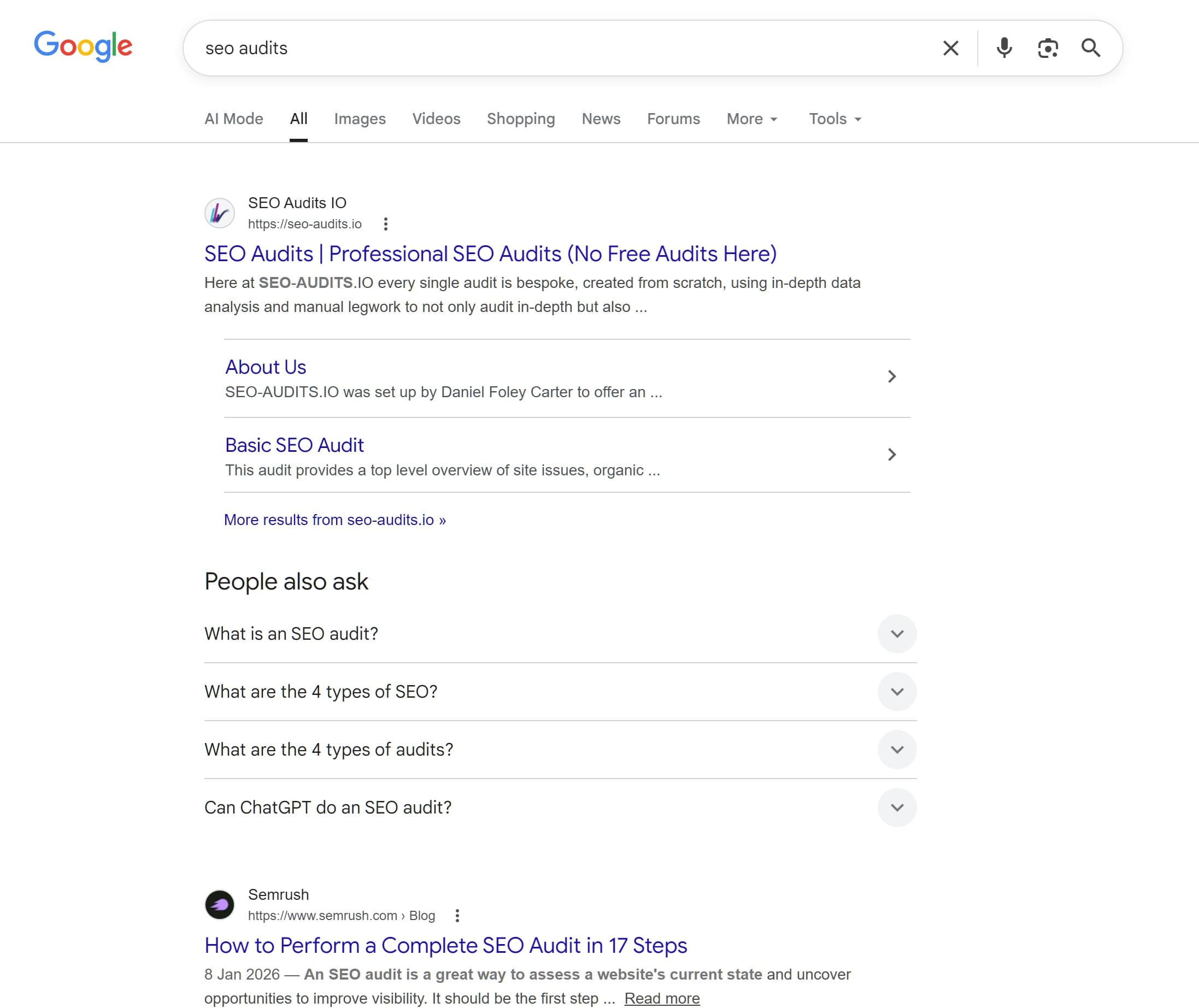
Assertive owns a dedicated SEO audit sub brand (seo-audits.io). We launched our own specialist SEO audit brand back in 2020 to provide a dedicated & specialised service when it came to audits. We've got extensive experience & we run a 5.0 rating & rank #1 globally for SEO audits.
We offer SEO audits for any purpose, but generally see a majority of booked SEO audits tend to be a mix of the same general issues. All of our auditing is bespoke and carried out from scratch - we don't rely on the output of SEO tools.
5/5
Review Ratings
20+
Years Experience
300+
Audits Delivered
What Makes Our SEO Audits Different
- Book an audit quickly & easily through our streamlined process
- Provide a brief of your issue/challenge for targeted analysis
- Audits available as a one-time purchase with fixed pricing
- Ad hoc SEO consulting available post-audit for implementation
- 300+ audits delivered with 5/5 star rating & 20+ years experience
- Rank #1 globally for 'SEO audits' - we practice what we preach
Trusted by Leading Businesses
We've delivered comprehensive SEO audits for companies across industries, helping them identify opportunities and achieve remarkable growth.

SEO audit and support for Lenovo's marketing hub helping with lead generation.
We worked with BNP Paribas Warranty Direct brand on SEO, PPC & Auditing to drive up new policies.

SEO audit and ongoing SEO support for an online pharmaceuticals brand to drive up medicine sales.

We worked with Audley Travel on SEO auditing and support providing a comprehensive SEO audit.

We provided SEO auditing, SEO support & PPC management for the Justerinis & Brooks brand.

We provided SEO auditing & SEO Support for SQS to help drive up group website organic performance.

We performed a comprehensive SEO audit for Shop Indoor Golf followed by an SEO strategy.

We provided Fast Loan UK with a comprehensive SEO audit & assessment of traffic loss with recommendations.

We provided Casinofy with a detailed SEO audit and SEO support, audit to identify impact from HCU.

We performed a pre and post-domain migration audit for Virgin Pure to Our Taap.

We performed a behemoth SEO audit on Casino.org along with SEO recommendations & strategy.

We performed a thorough SEO audit for Sytner's child brand The Car Shop covering all SEO issues.
Who's It For
Stop Guessing Your SEO Issues & Get Insights & Actionable Recommendations
Our SEO audits are suitable for businesses & website owners who have all sorts of issues from traffic losses and indexing issues through to addressing upcoming changes such as domain name changes or CMS changes. Who are our SEO audits suitable for?
- Businesses who've lost traffic, rank & revenue
- Businesses migrating domains or CMS
- Businesses not seeing growth or stagnancy
- Businesses looking for a second SEO opinion
- Businesses planning website changes
- Businesses looking for organic growth
SEO Audit Use Cases
We offer SEO audits for any purpose, but generally see a majority of booked SEO audits tend to be a mix of the same general issues which we cover below.
SEO Audit Use Case:
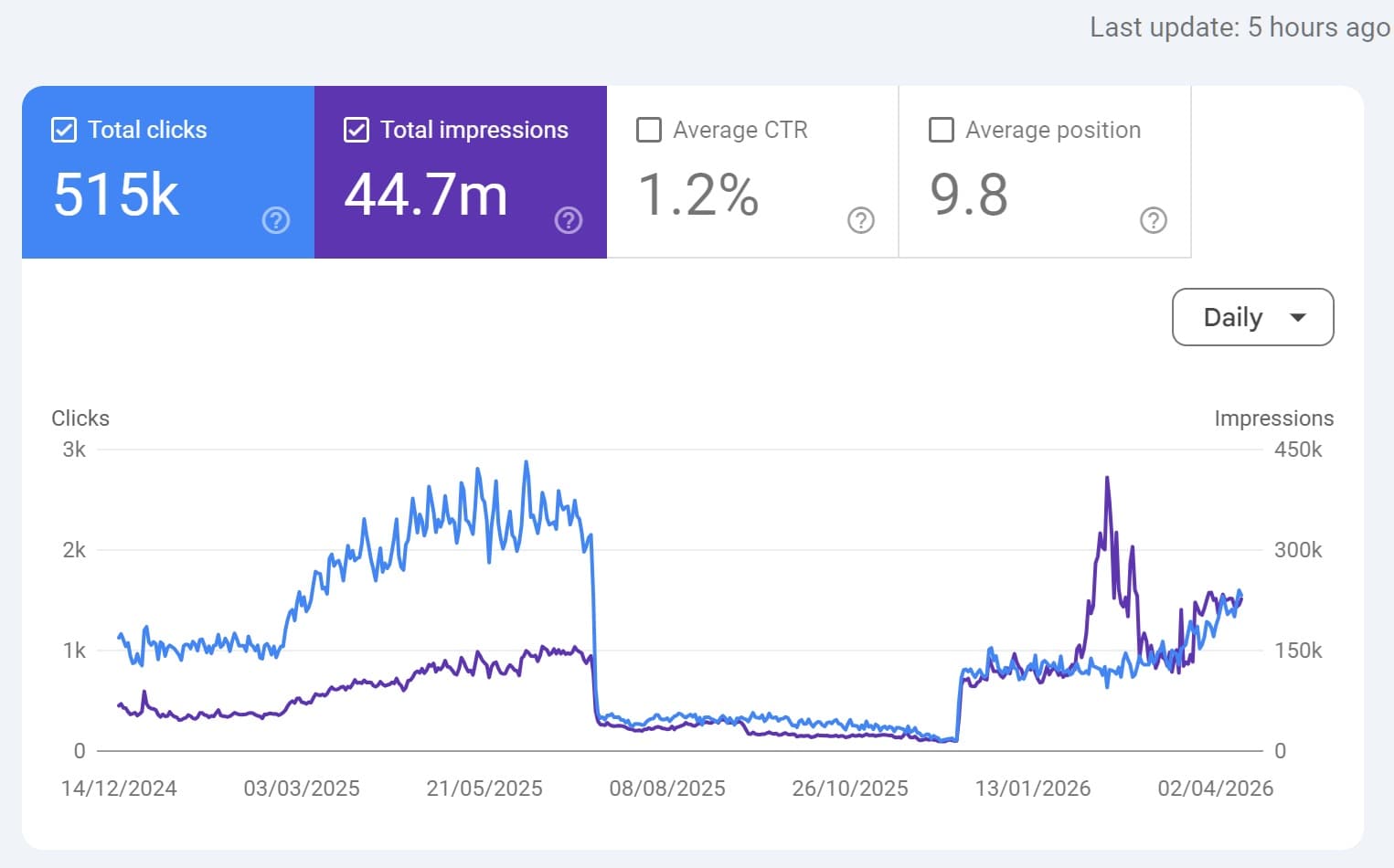
Traffic & Ranking Recovery Auditing
The most common audit booking we handle. Businesses come to us after a ranking or traffic drop they can’t explain, usually following a Google update, a site migration, or a redesign they thought was routine. Drops look similar on a chart but the causes differ wildly: core update devaluation, Helpful Content suppression, cannibalisation from new content, broken canonical handling, a silent drop in crawl rate, or a competitor muscling into your SERPs.
Our approach works backwards from the data. We pull historical Search Console performance, overlay it against confirmed Google update dates, segment by page type, query intent and device, then work through technical and content hypotheses until we can explain the decline properly. No guessing, no “it’s probably an update.”
You get a written diagnosis, a prioritised recovery roadmap, and a realistic timeline based on how Google actually re-evaluates sites. Recovery isn’t guaranteed, but knowing exactly what went wrong is the foundation for any fix that works.
SEO Audit Use Case:
Technical SEO Auditing
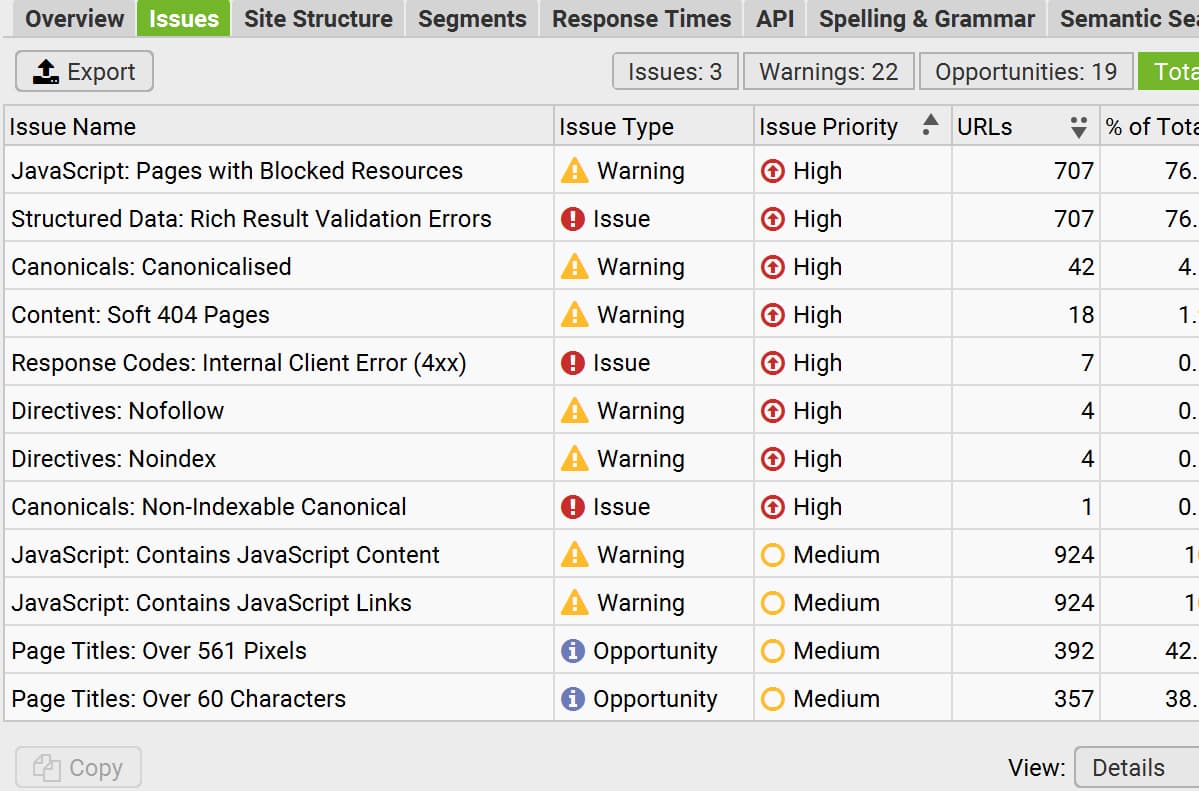
A full technical audit covering the complete stack of indexing and crawl signals: rendering (SSR, CSR, ISR, hybrid setups), crawlability, indexability, site architecture, internal linking distribution, structured data implementation, Core Web Vitals, hreflang, canonical handling, robots directives, XML sitemaps, and log file analysis where available.
Technical SEO problems are rarely visible in keyword tracking tools. They show up as slow indexation, missing rich results, pages stuck in “Discovered, currently not indexed,” JavaScript content Google never sees, or subtle crawl inefficiencies that waste budget on junk URLs while your money pages sit uncrawled for weeks.
Our audit identifies every technical issue affecting how Google and LLM crawlers access, render and rank your site. You get a severity-ranked issue list, clear remediation steps written for your development team, and where needed, the exact code or configuration changes required to fix things properly.
SEO Audit Use Case:
CMS & Tech Stack Changes
Moving from WordPress to Webflow, Shopify to headless, Magento to Shopify, or spinning up a Next.js front-end on top of your existing back-end: every CMS or framework change introduces SEO risk that only becomes visible after the switch, usually when traffic has already dropped.
We audit before and after. Pre-migration, we map every indexed URL, document current technical configurations (canonical rules, redirect logic, structured data, internal linking patterns, template-level behaviours), and flag anything the new stack handles differently. Post-migration, we verify nothing broke silently: rendering has shifted as expected, pagination still works, redirects fire correctly, structured data survived, and Google is crawling the new templates the way it crawled the old ones.
The goal is a migration Google barely notices. Done properly, rankings hold through the transition. Done badly, you can lose 30–60% of organic traffic inside a week and spend six months clawing it back.

SEO Audit Use Case:
Domain Migration / Acquisitions
Buying an expired or aged domain, merging two brands, acquiring a competitor, or switching your primary domain all carry SEO consequences that need to be understood before contracts are signed, not after.
Our pre-acquisition audit covers the domain’s full history: link profile quality and anchor text patterns, indexation history, previous penalties or manual actions (including ones that have expired but left residual patterns), Wayback Machine content history, and whether the domain has been used for spam, PBNs or cloaking at any point. A cheap domain with 50,000 backlinks is often cheap for a reason.
Post-acquisition, we plan and execute the migration properly: URL mapping, 301 redirect architecture, canonical consolidation, and a phased rollout that preserves equity rather than flushing it. You get an honest risk profile before you buy and a clean migration plan after.

SEO Audit Use Case:
Page Indexing Audits
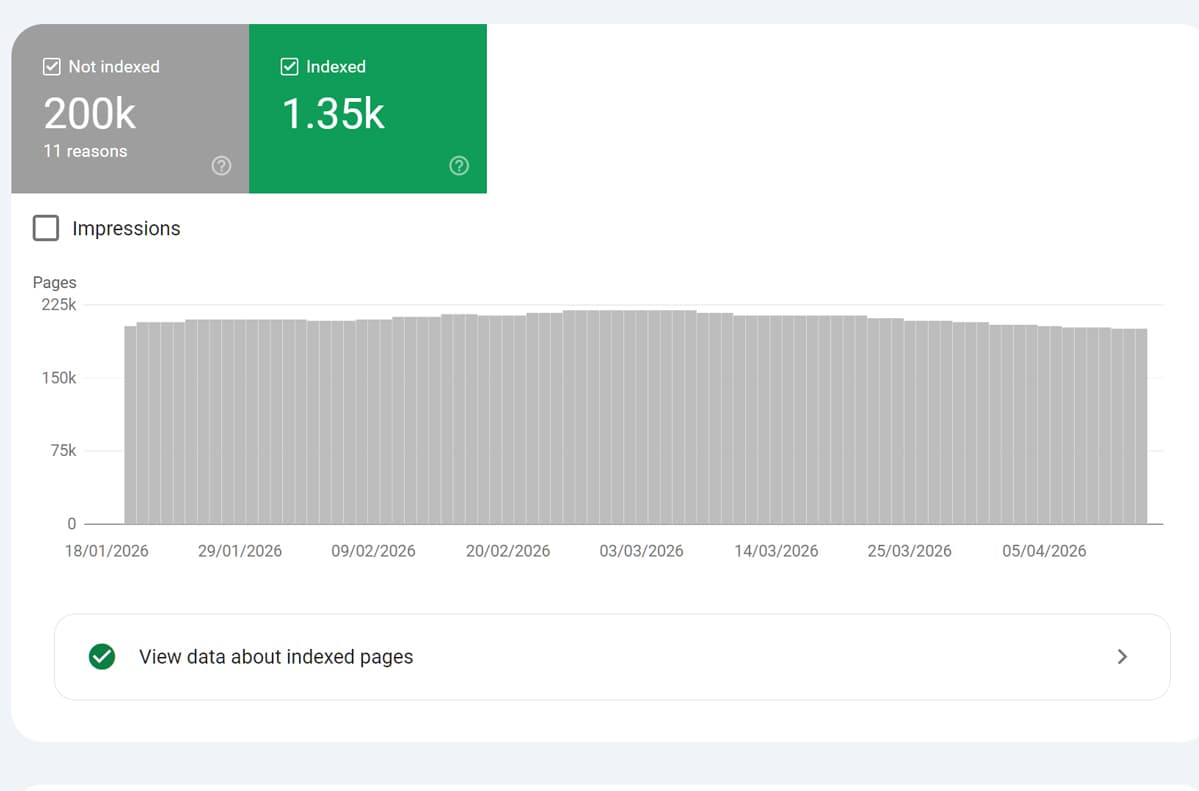
Pages not getting indexed is one of the most frustrating SEO problems because the cause is often invisible from the outside. “Crawled, currently not indexed” and “Discovered, currently not indexed” have become catch-all statuses covering quality classification, duplicate content detection, soft 404s, crawl budget exhaustion, template-level issues, and internal linking problems.
We diagnose indexing issues at both the page level and the site level. That means pulling GSC Index Coverage data properly (not just the UI summary), checking server logs for Googlebot behaviour, reviewing how your CMS or framework handles canonical signals, and identifying whether the problem is technical, qualitative, or structural.
Most indexing issues have specific fixes once you know the cause. Thin pages need consolidation or removal. Duplicate clusters need canonical discipline. Crawl budget problems need faceted URL control and sitemap hygiene. We tell you which applies and what to do about it.
SEO Audit Use Case:
Manual Actions & Penalties
If you’ve received a manual action in Search Console, or suspect algorithmic suppression without a notification, the remediation process is specific and unforgiving. Guessing doesn’t work. Reconsideration requests that lack evidence get rejected, and rejected requests make subsequent ones harder.
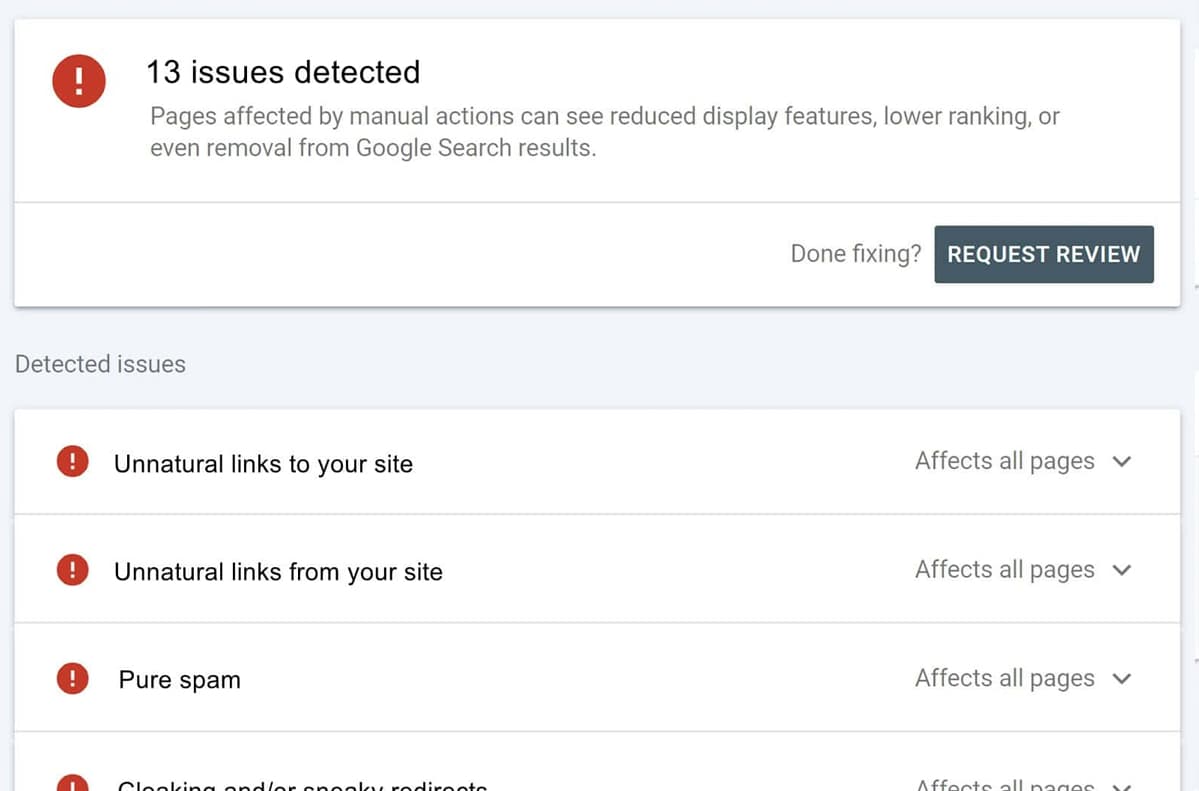
We handle the full diagnostic and remediation cycle: identifying the action type (thin content, unnatural links to your site, unnatural links from your site, user-generated spam, pure spam, structured data abuse, cloaking, hidden text), evidencing the cause with data, executing the cleanup work, and drafting the reconsideration request with the level of detail Google’s spam team actually wants to see.
Algorithmic penalties, where there’s no manual action but sustained suppression, are harder and take longer. We help you distinguish between the two, because the recovery paths are completely different and conflating them wastes months.
SEO Audit Use Case:
Link Building Audits
Two sides to this: auditing your existing backlink profile for toxic patterns, and auditing the quality of link building campaigns (yours or an agency’s) to check you’re actually getting what you’re paying for.
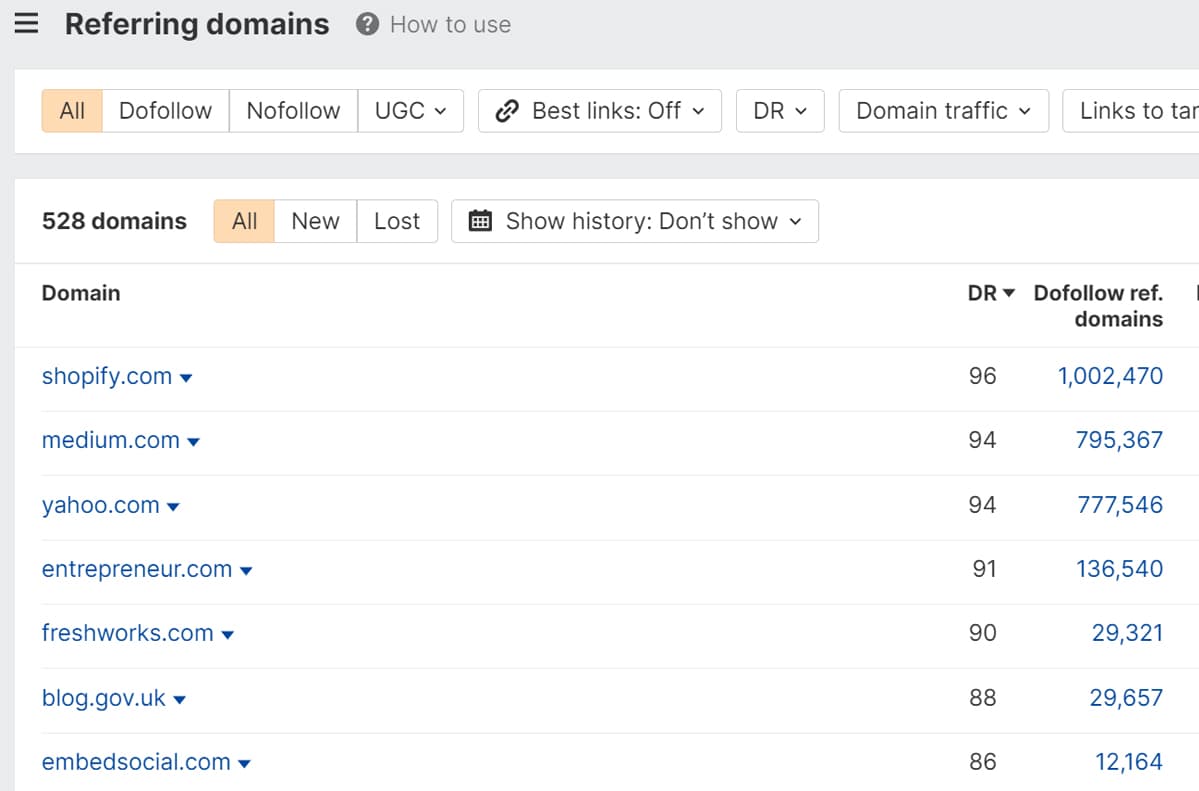
Profile audits look at anchor text distribution, link velocity, referring domain quality, topical relevance, and patterns that look algorithmically suspicious: money anchor over-optimisation, foreign language spam clusters, forum profile networks, and PBN footprints. Not every bad link needs disavowing, but patterns at scale do.
Campaign audits look at what’s being built on your behalf. Real editorial placements on sites with real traffic, or recycled guest post networks anyone with the same template can access for £50? DR scores that don’t match actual authority? Links from sites that exist only to sell links? We tell you whether your link budget is being spent on assets that move rankings, or on the appearance of them.
SEO Audit Use Case:
Full Scope SEO Audits
Everything combined in one engagement: Search Console performance review, full technical SEO audit, page indexing analysis, content quality and coverage assessment, internal linking architecture review, backlink profile audit, Core Web Vitals analysis, and competitor benchmarking.
This is the audit for businesses who know something is wrong but can’t narrow it down, or for companies who want a complete baseline before committing to a long-term SEO strategy. Rather than looking at one slice of the problem, we assess every lever that affects organic visibility and rank them by impact and effort.
You get a prioritised roadmap covering the next 3, 6 and 12 months, with specific work packages, expected impact per fix, and a clear view of what matters most versus what’s just noise. Not a 200-page PDF full of generic findings. A strategic document written to be executed against.
How the SEO Audit Booking Process Works
Our streamlined process ensures you get the insights you need quickly and efficiently.
Step 01
Get in Contact
Get in contact with Assertive to have a preliminary discussion about your SEO audit needs, or if you already know what you want, you can book your audit directly through our website.
Step 02
Pay & Book Your SEO Audit
If booking a bespoke audit we'll provide a cost quote. Once agreed, an invoice will be provided for payment. On payment, you'll receive a booking confirmation with all details.
Step 03
Provide Your Brief & Grant Access
Provide a written brief of what you want from the audit, key areas of concern, focus or priority. We'll request Google Search Console / GA4 access & any auxiliary data needed.
Step 04
Audit Begins & Updates Commence
As we begin the audit, we'll provide regular updates on progress. We can keep you updated via email, Slack, Teams & other communication channels as needed.
Step 05
Audit Delivery & Post Audit Support
Once ready, we'll email all documentation with a TLDR. We can arrange calls to discuss findings and provide post-audit consultancy or retained SEO services for implementation.
What Our Clients Say About Our SEO Audits
Don't just take our word for it - here's what businesses say about our audit process and results.
“We initially hired Assertive for an audit but that's since gone on to full time SEO support. The audit was nothing short of being very impressive, very detailed & to the point. The audit provided lots of clarity about what we had and what we needed to do moving forwards.”
Mark Osborne
Verified Buyer
5/5
Review Ratings
20+
Years Experience
300+
Audits Delivered
SEO Audit Pricing
SEO Audits are bespoke so pricing is generally tailored. We provide fixed cost audits, but in cases where requirements are bespoke, a quote can be provided.
Audits START from £2,000. To give an indication of pricing:
Technical SEO Audits
$3,000
Comprehensive technical analysis covering crawling, indexing, site performance, and rendering issues.
- Complete technical SEO analysis
- Full site crawlability assessment
- Technical SEO recommendations
- Site performance assessment
- Rendering & DOM analysis
- Structured data validation
- Internal link & anchor evaluation
- HTTP Header checks
- Crawl log analysis
- URL handling & parameters
- Indexability & management
- AI & LLM accessibility
Traffic & Ranking Recovery
$4,500
Specialized audits for businesses experiencing traffic drops or ranking losses.
- Full search console assessment
- Traffic loss root cause analysis
- Ranking decline investigation
- Algorithm update impact assessment
- Recovery strategy development
- Performance monitoring setup
- Content evaluation & audit
- Page indexing evaluation & audit
- Link evaluation & audit
- User engagement analysis
- Strategic SEO test recommendations
- Onward recovery strategy
Behemoth SEO Audits
$7,500
Complete enterprise-level audits covering every aspect of SEO performance and strategy.
- Full-scope SEO analysis
- Full search console audit
- Full technical SEO audit
- Page indexing audit
- Content audit
- Rendering & performance audit
- Link audit
- User behaviour audit
- Consulting calls
- Enterprise-level reporting
- Custom strategic recommendations
- Multi-stakeholder presentations
- Ongoing strategic support
Additional Audit Services
CMS/Domain Migration Audit
$5,000
A comprehensive SEO audit for businesses who are looking to change their domain or content management system. Prevent ranking losses, preserve rank.
- Pre-change assessment
- Search console analysis
- Core update analysis
- Indexing audit
- Technical SEO audit
- CMS to CMS comparison
- Content output evaluation
- Rendering & performance test
- Like for Like preservation
- Domain background check
- Link check
- CMS/Domain migration plan
Content Audit
$2,500
A professional content audit to evaluate content quality, NLP, intent, performance & strategic guidance based on content quality, output, methodology etc.
- Full content audit
- Google search console review
- Content NLP review
- Content quality review
- Content intent alignment
- Content benchmarking
- E-E-A-T/YMYL checks
- Authorship
- Brand & content trust
- Forward guidance
Link Audit
$2,500
A professional backlink audit to review your domains trust, strength and perceived quality. A clear and concise audit to weigh up quality of built links & allocated spend.
- Full link audit
- Link quality assessment
- Link accruement review
- Link neighbourhood review
- Link networks & tiered links
- Link distribution to pages
- Referring domain by traffic
- Analysis of link types
- Evaluation of topical trust flow
- Link context analysis
- Anchor utilisation review
SEO Audit Client Case Study
How We Helped Rider Guide to Recover & Grow Organic Traffic Post Audit
We worked with Electric Scooter Guide & their migration to Rider Guide, we helped to resolve traffic losses and impacts from Google's core updates including helpful content, we've also helped them to negate click losses due to AI overviews.
We performed a ranking & traffic recovery audit and then offered post audit support.
Traffic recovered within 2 months of audit execution, we've since seen onward growth. We helped to address issues with poor user experience, content issues and issues with technical SEO post domain migration.
Book an SEO Audit
What's Included in our SEO Audits
Learn more about what's included in our SEO audits. Each SEO audit is bespoke, we perform thorough tear-downs of websites & take into consideration client needs, website issues, impacts from work or google core updates and more. We don't automate SEO audits because we believe a big part of what makes an audit great is true attention to detail. We don't use SEO tools to generate audits, nor do we use AI to analyse and recommend, primarily because of things such as hallucinations in data.
Crawlability
- •robots.txt syntax, reachability (200 status), not accidentally blocking CSS/JS
- •robots.txt not blocking critical subfolders, staging leaks, or pagination
- •Crawl-delay directives (respected by Bing/Yandex, ignored by Google)
- •User-agent specific rules (Googlebot, Googlebot-Image, Googlebot-News, Bingbot, AI bots)
- •XML sitemap referenced in robots.txt
- •Crawl budget waste (parameter URLs, infinite spaces, calendar traps, internal search)
- •Spider traps (session IDs in URLs, relative links gone wrong, infinite pagination)
- •Orphan pages (in sitemap/GA/logs but no internal links)
- •Click depth from homepage (aim ≤3 for priority pages)
- •Internal link equity distribution
- •Broken internal links (4xx/5xx)
- •Broken outbound links
- •Redirect chains (>2 hops)
- •Redirect loops
- •Soft 404s
- •Server log analysis: crawl frequency by template, wasted crawl, bot verification via reverse DNS
- •Googlebot verification (reverse + forward DNS lookup)
- •Crawl rate vs server capacity
- •Rate-limiting / firewall blocking legitimate bots
- •Cloudflare / WAF bot-fight mode blocking Googlebot
- •IP allowlisting issues for staging environments leaking to index
Indexation
- •Index coverage report review (GSC)
- •Indexed vs submitted vs valid pages ratio
- •"Crawled – currently not indexed" patterns
- •"Discovered – currently not indexed" patterns
- •"Alternate page with proper canonical tag" volume
- •"Duplicate without user-selected canonical"
- •noindex tag placement (in <head>, not body)
- •noindex in HTML vs X-Robots-Tag header
- •noindex accidentally on production pages
- •Index bloat (tag pages, author archives, thin category pages, internal search results)
- •Thin content pages indexed
- •Staging/dev environments indexed
- •HTTP pages indexed alongside HTTPS
- •www and non-www both indexed
- •Trailing slash vs non-trailing slash both indexed
- •Uppercase/lowercase URL duplicates
- •index.html / default.aspx duplicate indexation
- •Query parameter duplicates indexed
- •Faceted navigation duplicates
- •Print versions / AMP / PDF duplicates
- •URL Inspection tool spot-checks for key templates
Canonicalisation
- •Self-referencing canonicals present on all indexable pages
- •Canonical tag in <head> only
- •Single canonical per page (no duplicates)
- •Canonical pointing to indexable, 200 URL (not redirected, not noindexed)
- •Canonical not pointing to a different language/country version
- •Canonical not conflicting with hreflang
- •Canonical not conflicting with sitemap inclusion
- •Canonical not conflicting with internal linking
- •Canonical via HTTP Link: header where needed (PDFs, non-HTML)
- •Canonicals on paginated pages (self-referencing, not pointing to page 1)
- •Canonicals on filtered/faceted URLs
- •Protocol/host consistency in canonicals (absolute URLs)
Status Codes & Redirects
- •200 on all indexable pages
- •301 for permanent moves (not 302/307)
- •308 where method preservation matters
- •410 for permanently removed content (vs 404)
- •503 with Retry-After during maintenance
- •No meta-refresh redirects
- •No JavaScript redirects for SEO-critical flows
- •No redirect chains or loops
- •HTTPS enforcement via 301 (not just HSTS)
- •www ↔ non-www single redirect, not chained
- •Trailing slash canonical form enforced via redirect
- •Mixed-case URL redirects to lowercase
- •Legacy migration redirect map preserved and monitored
- •404 page returns 404 status (not 200 "soft 404")
Sitemaps
- •XML sitemap present and valid
- •Sitemap index for large sites (<50k URLs / <50MB per file, gzipped where possible)
- •Only canonical, indexable, 200-status URLs included
- •No noindexed / redirected / 404 URLs in sitemap
- •lastmod accurate and updating on real content change
- •Dynamic sitemap generation tied to CMS
- •Image sitemap (or image extensions in main sitemap)
- •Video sitemap with required fields
- •News sitemap (if qualifying publisher)
- •hreflang in sitemap as alternative to tags
- •Submitted in GSC + Bing WMT
- •IndexNow submission for fast changes
- •Sitemap referenced in robots.txt
URL Structure
- •Readable, lowercase, hyphen-separated slugs
- •Short, keyword-relevant paths
- •Logical hierarchy matching information architecture
- •No stop-word bloat
- •No session IDs or tracking params in canonical URLs
- •Consistent trailing-slash policy
- •Parameter order consistency
- •Stable URLs (avoid rewriting historic URLs)
- •Protocol/host consistency across all internal links
Site Architecture & Internal Linking
- •Clear, shallow taxonomy
- •Topical siloing / hub-and-spoke structure
- •Breadcrumbs with BreadcrumbList schema
- •Contextual in-body links, not just nav
- •Anchor text diversity and relevance
- •Priority pages receive the most internal links
- •Avoid "nofollow" on internal links
- •No JavaScript-only links (use real <a href>)
- •Footer links not bloated / not keyword-stuffed
- •Mega menu links rendered in HTML, not behind JS-only events
- •Related content / "next step" links on money pages
- •HTML sitemap for large sites
- •PageRank sculpting (or at least, avoiding obvious equity leaks)
- •Facet/filter links handled (nofollow, disallow, or controlled)
Pagination
- •Real paginated series with distinct content
- •Self-referencing canonicals on each page (not all to page 1)
- •Crawlable <a> links between pages
- •rel="next"/"prev" (optional, deprecated by Google but still used by Bing)
- •View-all page where practical
- •Paginated pages indexable unless deliberately noindexed
Faceted Navigation
- •Crawlable facets deliberately chosen
- •Non-indexable facets blocked via robots.txt / noindex / canonical
- •Parameter handling strategy documented
- •PRG (POST-Redirect-GET) pattern or AJAX for low-value facets
- •No combinatorial explosion indexed
JavaScript / Rendering
- •SSR, SSG, or reliable dynamic rendering for critical content
- •Rendered HTML contains primary content, links, metadata
- •Rendered DOM vs view-source diff reviewed
- •Critical content not hidden behind user interaction
- •Links use <a href>, not onclick handlers
- •Lazy-loaded content accessible to crawlers (IntersectionObserver + native lazy-load)
- •Infinite scroll has paginated fallback with crawlable URLs
- •History API (pushState) used correctly for SPA routes
- •No JS errors blocking render
- •Hydration mismatches checked
- •Render budget: content available without excessive JS execution
- •Googlebot's WRS compatible JS (modern ES features generally fine, but check)
- •Third-party scripts not blocking rendering
- •User-agent cloaking check (same content to bots and users)
- •Mobile vs desktop rendered content parity
Core Web Vitals & Performance
- •LCP < 2.5s (75th percentile, field data)
- •INP < 200ms
- •CLS < 0.1
- •TTFB < 800ms
- •FCP benchmark
- •TBT (lab) as INP proxy
- •CrUX data review per template
- •PageSpeed Insights + Lighthouse audits per template
- •WebPageTest runs for waterfall analysis
- •Image optimisation: WebP/AVIF, correct dimensions, srcset/sizes
- •Native loading="lazy" on below-fold images
- •Priority hints (fetchpriority="high") on LCP element
- •Preload critical resources (fonts, hero image)
- •Preconnect / dns-prefetch to critical third parties
- •Font loading: font-display: swap, subsetting, self-hosting
- •Critical CSS inlined, rest deferred
- •Defer / async non-critical JS
- •Code splitting
- •Unused CSS/JS removal
- •Compression: Brotli / gzip
- •HTTP/2 or HTTP/3 enabled
- •CDN in place with good POP coverage
- •Cache-Control / ETag / Last-Modified headers correct
- •Static asset cache TTLs long with versioned filenames
- •Server response time / origin performance
- •Edge caching for HTML where possible
- •Third-party script audit (tag manager bloat)
- •Reserve space for images/ads/embeds (no CLS)
- •Avoid late-injected banners / cookie bars pushing layout
Mobile
- •Mobile-first indexing readiness
- •Responsive design (preferred) or consistent dynamic serving
- •Content parity between mobile and desktop
- •Structured data parity
- •Metadata parity
- •Internal links parity
- •Viewport meta tag present and correct
- •Tap target sizing
- •Readable font sizes without zoom
- •No interstitials / intrusive pop-ups on mobile
- •Mobile Core Web Vitals specifically (field data differs from desktop)
HTTPS & Security
- •Valid SSL/TLS certificate, not expiring
- •TLS 1.2+ (TLS 1.3 preferred)
- •No mixed content (HTTP resources on HTTPS pages)
- •HSTS header with reasonable max-age, includeSubDomains, preload (if appropriate)
- •HTTPS enforced via 301 from HTTP
- •Secure cookies, SameSite attributes
- •No security warnings in GSC
- •Not flagged in Safe Browsing
- •CSP / security headers where appropriate (not blocking legitimate bots or resources)
Metadata
- •Unique title tags per page
- •Title length ~50–60 chars (pixel-aware)
- •Primary keyword placement in title
- •Brand placement consistency
- •Unique meta descriptions per indexable page
- •Meta description ~150–160 chars
- •No auto-generated, thin, or duplicate descriptions on key pages
- •Meta robots directives correct (index/follow defaults, noindex where intended)
- •X-Robots-Tag consistency with meta robots
- •Open Graph tags (og:title, og:description, og:image, og:url, og:type)
- •Twitter Card tags
- •Favicon / touch icons present and correct sizes
- •<html lang> attribute set correctly
- •Charset declared early in <head>
Headings & On-Page Structure
- •Single <h1> per page (or semantic equivalent)
- •Logical heading hierarchy (no skipping levels)
- •Descriptive, keyword-relevant headings
- •Semantic HTML (header, nav, main, article, section, aside, footer)
- •Content in <main> not buried in nested divs
Structured Data
- •JSON-LD preferred over microdata/RDFa
- •Schema present on all eligible templates
- •Organization / Website / SearchAction on homepage
- •BreadcrumbList on category/product/article pages
- •Product / Offer / AggregateRating / Review on product pages
- •Article / NewsArticle / BlogPosting with author, datePublished, dateModified
- •Author schema with sameAs entity links
- •FAQPage (where still eligible and genuine)
- •HowTo (where still eligible)
- •LocalBusiness with NAP, openingHours, geo
- •Event, Recipe, VideoObject, Course, JobPosting as relevant
- •Service / ProfessionalService for agencies
- •SoftwareApplication for SaaS
- •Validated via Schema.org validator + Rich Results Test
- •No warnings / errors in GSC Enhancements
- •Schema matches visible content (no ghost reviews/prices)
- •Nested schema with @id references for entity graph
- •sameAs pointing to Wikipedia, Wikidata, Crunchbase, LinkedIn, socials
International / Multi-Region
- •hreflang on every language/country variant
- •Self-referencing hreflang on each page
- •Return tags (bidirectional) for every alternate
- •x-default for selector/homepage
- •ISO 639-1 language + ISO 3166-1 Alpha-2 country codes correct
- •hreflang in HTML, HTTP header, or sitemap (pick one consistently)
- •Canonical aligned with hreflang (same-language canonical, not cross-language)
- •ccTLD / subdomain / subfolder strategy documented
- •GSC international targeting (legacy, mostly gone)
- •Currency, language, locale rendered correctly per region
- •Geo-IP redirects avoided (or done with care and a manual override)
Images
- •Descriptive alt text (empty alt for decorative only)
- •Meaningful filenames
- •Next-gen formats (WebP/AVIF) with fallbacks
- •Responsive images via srcset / <picture>
- •Width and height attributes set (prevents CLS)
- •Compression (lossy where acceptable)
- •Image CDN / on-the-fly resizing
- •EXIF stripped (unless intentional)
- •ImageObject schema where useful
Video
- •VideoObject schema (thumbnail, duration, uploadDate, contentUrl/embedUrl)
- •Video sitemap
- •Transcripts and captions
- •Poster images
- •Lazy-loaded iframes (facade pattern)
- •Key moments markup (Clip / SeekToAction)
Content Quality & Duplication (Technical Side)
- •Thin/low-value pages identified
- •Near-duplicate detection across templates
- •Keyword cannibalisation audit
- •Product description uniqueness (especially for manufacturer-fed copy)
- •Boilerplate-to-unique ratio per page
- •Indexable tag/archive pages evaluated
- •Search-results pages blocked
- •Internal search indexation prevented
Log File Analysis
- •Googlebot hit distribution by URL / template / status code
- •Crawl waste on parameter URLs, 404s, redirects
- •Time since last crawl for priority URLs
- •Googlebot Smartphone vs Desktop ratio
- •Other bots' behaviour (Bingbot, GPTBot, ClaudeBot, PerplexityBot, Applebot)
- •Server errors seen by bots
- •304 Not Modified responses for static assets
Search Console
- •Property verification (Domain property preferred)
- •Sitemaps submitted and clean
- •Page Indexing report trend monitoring
- •Core Web Vitals report
- •Page Experience
- •Mobile Usability
- •Manual Actions
- •Security Issues
- •HTTPS report
- •Links report (internal + external)
- •Crawl Stats (response time, file types, purpose, by response)
- •Performance data by query, page, country, device
- •Shopping / Merchant reports (if applicable)
- •Video Indexing report
- •URL Inspection for priority templates
Bing & Alternative Engines
- •Bing Webmaster Tools verification + sitemap
- •IndexNow integration (Bing, Yandex, Seznam, Naver)
- •Yandex Webmaster (if targeting RU)
- •Baidu considerations (if targeting CN)
AI / LLM / GEO
- •llms.txt file (emerging standard)
- •GPTBot, ClaudeBot, PerplexityBot, Google-Extended, CCBot, Applebot-Extended access decisions in robots.txt
- •Content structured for LLM extraction (clear headings, definitional sentences, lists)
- •Entity clarity (clear subject per page, consistent naming)
- •Brand mentions across authoritative sources
- •Wikipedia / Wikidata entity presence
- •Consistent sameAs across schema
- •Structured data for entity disambiguation
- •Author entities (sameAs to LinkedIn, Twitter, Wikipedia where applicable)
- •FAQ-style phrasing in pages likely to be cited
- •Freshness signals (dateModified) on time-sensitive content
E-Commerce Specific
- •Product schema with price, availability, SKU, GTIN/MPN, brand
- •Out-of-stock handling (don't 404 permanent products; keep URL, update schema)
- •Variant handling (canonical parent vs indexable variants)
- •Faceted nav governance
- •Review schema only from genuine first-party reviews
- •Merchant Center feed alignment with on-page data
- •Product identifiers consistent across feed, schema, URL
- •Category page content (intro copy, FAQs, internal links)
- •Search results pages not indexed
- •Filtered "inventory zero" pages handled
News / Editorial
- •Article schema with author, publisher, datePublished, dateModified, headline, image
- •Clear byline with author page linked
- •Author E-E-A-T signals (bio, credentials, sameAs)
- •News sitemap for qualifying publishers
- •Google News publisher requirements met
- •Fast update of dateModified on meaningful edits (not trivial)
Local SEO (Technical Slice)
- •Google Business Profile claimed, verified, optimised
- •NAP consistency across site, schema, citations
- •LocalBusiness schema with geo, areaServed, openingHours
- •Per-location landing pages with unique content
- •Location schema on each location page
- •Embedded map where useful
- •hCard-style contact info in footer
Accessibility (SEO-Adjacent)
- •Semantic HTML and ARIA where appropriate
- •Keyboard navigation
- •Colour contrast
- •Skip-to-content links
- •Form labels
Server / Infrastructure
- •Uptime monitoring
- •Server response time under load
- •Geographic origin appropriate for primary audience (or CDN compensating)
- •HTTP/2 or HTTP/3 enabled
- •Keep-alive enabled
- •Correct Vary headers (Accept-Encoding; User-Agent only if actually varying)
- •Proper Content-Type headers
- •Correct language / charset headers
- •No 5xx errors in GSC Crawl Stats
- •Origin cache rules consistent with CDN
You will receive a Google Slides deck along with any relevant PDFs, Google Sheets and videos. We provide deliverables tailored around the target client's needs. For example, if we're producing a technical SEO audit and this is going to your development agency we prioritise recommendations and give clear guidance on implementation. When you book your audit, you can specify the format you want and any key things you want us to cover, prioritise etc. Your audit will typically include:
Written Audit Report
A full written report documenting every finding, the evidence behind it, and its impact on organic performance. Findings are grouped by category (technical, indexing, content, links, architecture) and severity-ranked so you know what matters most. No padding, no 40-page executive summaries regurgitating the same three points in different formats. The length is determined by what we found, not by what looks impressive.
Prioritised Remediation Roadmap
Every issue identified comes with a specific fix, the effort required to implement it, and the expected impact on rankings or indexation. Issues are sequenced into a roadmap covering what to fix this week, this month, and this quarter. You get a clear view of where to start and why, rather than a list of 300 problems with no indication which ones actually move the needle.
Developer-Ready Documentation
Technical recommendations are written to be handed directly to your development team. That means specific code changes, configuration examples, template-level fixes, and where appropriate, pull request-ready specifications. Your developers shouldn't need an SEO translator to understand what we're asking them to do.
Data & Evidence Files
You receive the underlying data behind the audit: crawl exports, log file analysis outputs, GSC performance data, indexation reports, rendering comparisons, and any custom analysis we ran. If we claim something is broken, you get the data proving it.
Walkthrough Call
A live session walking you through the findings, answering questions, and making sure the priorities are clear before implementation starts. Recorded and sent across afterwards so anyone who wasn't on the call can catch up properly.
Follow-Up Support
30 days of follow-up support after delivery covering implementation questions, clarification on findings, and sense-checks on work your team or developers are doing based on the audit. Not a retainer, just making sure you actually get value from what we delivered.
SEO Auditing: Service Questions & Answers
Everything you need to know about our SEO audit process and services.
SEO Audits are bespoke so the pricing is generally tailored. We provide fixed cost audits, but, in cases where the requirements are bespoke a quote for an audit can be provided. Audits START from $2,500. To give an indication of pricing: Technical SEO Audits - $2,500 - $4,000 Link Audits - $2,500 Content Audits - $3,000 Traffic & Ranking Recovery Audits - $4,500 CMS / Domain Migration Audits - $3,000 Behemoth SEO Audits - $6,500+
The duration depends on the scope and complexity of the audit. A standard technical SEO audit typically takes 5-10 business days, while comprehensive behemoth audits may take 2-4 weeks. We provide clear timelines during the booking process.
Our audits are delivered as comprehensive documents including detailed analysis, findings, and actionable recommendations. We provide executive summaries with key findings and prioritized action items.
No, we do not offer free SEO audits. All of our auditing is bespoke and carried out from scratch - we don't rely on the output of SEO tools. Free audits typically provide surface-level insights. Our paid audits deliver genuine, actionable value.
Once your SEO audit is delivered, we can arrange a post-audit discussion call to walk through the findings, answer questions, and discuss implementation priorities. We can then provide post-audit consultancy services or retained SEO support to help with implementation of the audit recommendations. Our support covers everything from technical SEO implementation to content production, E-E-A-T optimization, UX improvements, and link building campaigns.
SEO Audit Benefits:
How SEO Audits Can Help Your Business Website
Our SEO audits are bespoke for each and every client and are tailored to address every type of issue. We've performed audits for hundreds of businesses globally helping with everything from addressing lost rankings & clicks due to Google core updates through to resolving issues with failed domain & CMS migrations through to CMS transitions. Our SEO audits can help your business with any scenario including:
- Your website lost clicks to Google AI overviews
- Your website lost rankings after a Google core update
- Your website lost rankings after a website revamp
- Your website lost rankings due to a Google penalty
- Your website lost rankings due to indexing issues
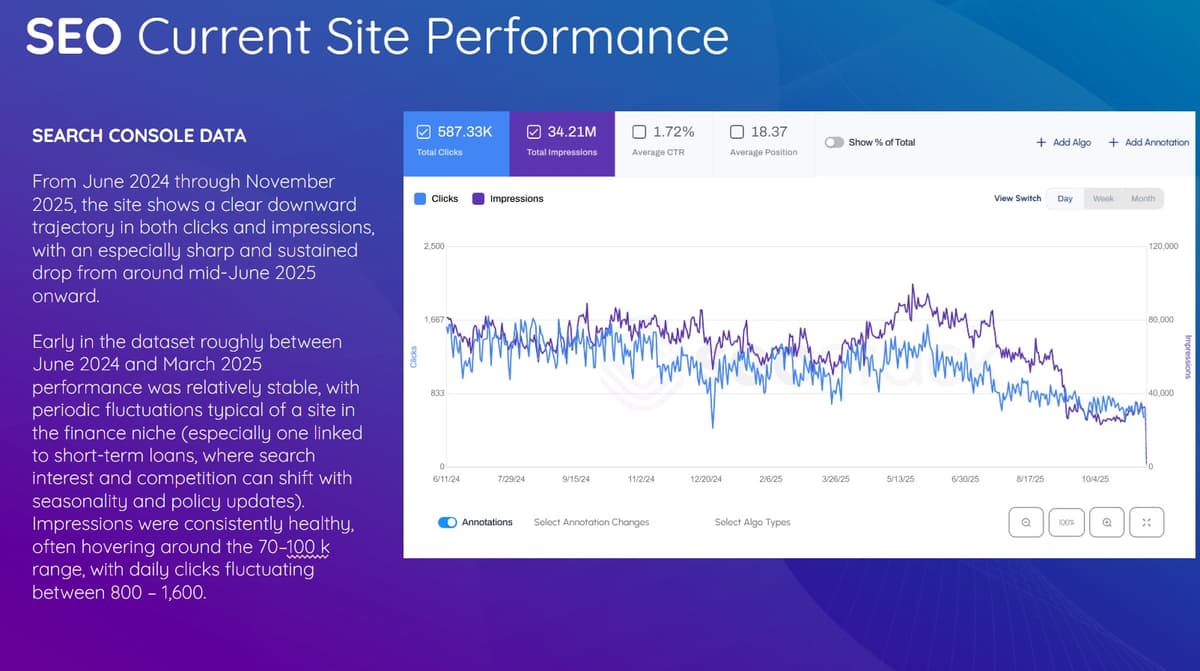
Whatever situation you may be in our team of specialist SEO auditors are trained to fully understand when, where and why you've lost traffic. We do a thorough investigatory tear-down. We look at your Google search console data, we segment and identify where the losses happened, we then investigate why, what caused it and what is the best course of action to drive recovery.
Each audit comes with a thorough tear-down of your data along with clear, concise and actionable recommendations to help initiate the recovery phase.
- Thorough, detailed audit of your website data
- Actionable recommendations with clear action priorities
- High, medium and low priority fix classifications
- Effort and technical debt estimates for each fix
- Google Search Console data segmentation & analysis
- Root cause identification: when, where and why traffic was lost
Audit Timelines:
How Long Do Audits Typically Take?
Every client situation and scenario is different. The things that impact how long an audit will take include:
The website's size and the degree of click loss
Why the click loss happened i.e. algorithmic issue, manual action, indexing issues
The current state of the website/domain (technical, content, links etc)
The amount of data that our team has to process
On average, audits can typically take 2-4 weeks, but regardless, if we begin an audit for your business and find anything glaringly obvious or critical to begin addressing before the audit is delivered, we'll let you know. We try and position recommendations by highest priority first. If there are things you can be getting on with whilst we continue with the work we'll send them ahead of audit completion.
This means your business isn't sat waiting around. We work to maximise efficiency and minimise time before you can begin getting fixes and improvements underway.
Good audits do take time, primarily because we aren't rushing. That's where a lot of audits and AI/automations go wrong. We manually assess every bit of data to ensure the recommendations we give you are the right ones and not based off of guesswork.
SEO Audit Process
SEO Audit Analysis: How it Works
The first thing we typically tend to do when identifying where and why losses occurred is to go through your Google search console data. Post signing an NDA and post gaining access to your Google search console data we then begin our analysis. Things we typically do include:
- Import your website into SEO Stack
- Full tear down of your search console data
- Brand vs Non Brand Analysis
- Marker checks (Google core updates against points of decline)
- Segment by Sub Folders
- Segment by Queries / Query Types
- Last 3 Month Year over Year Comparison
- New Pages vs Lost Pages
- URL Performance Group Analysis
When we segment the data, we can identify where the losses occurred. We tend to segment out brand and then look at performance by sub folders. For example, if you were on Shopify we'd segment out brand and then we'd look at /collections/, /products/, /blogs/, /pages/ and we'd look at where the losses are happening.
Your Google search console data is the first port of call for our analysis (unless we're doing a specific audit i.e. a link building audit).
Ready to Get Your SEO Audit?
Book a comprehensive SEO audit with our specialist team and get actionable insights to drive your organic growth.
Knowledge Hub