
 Daniel Carter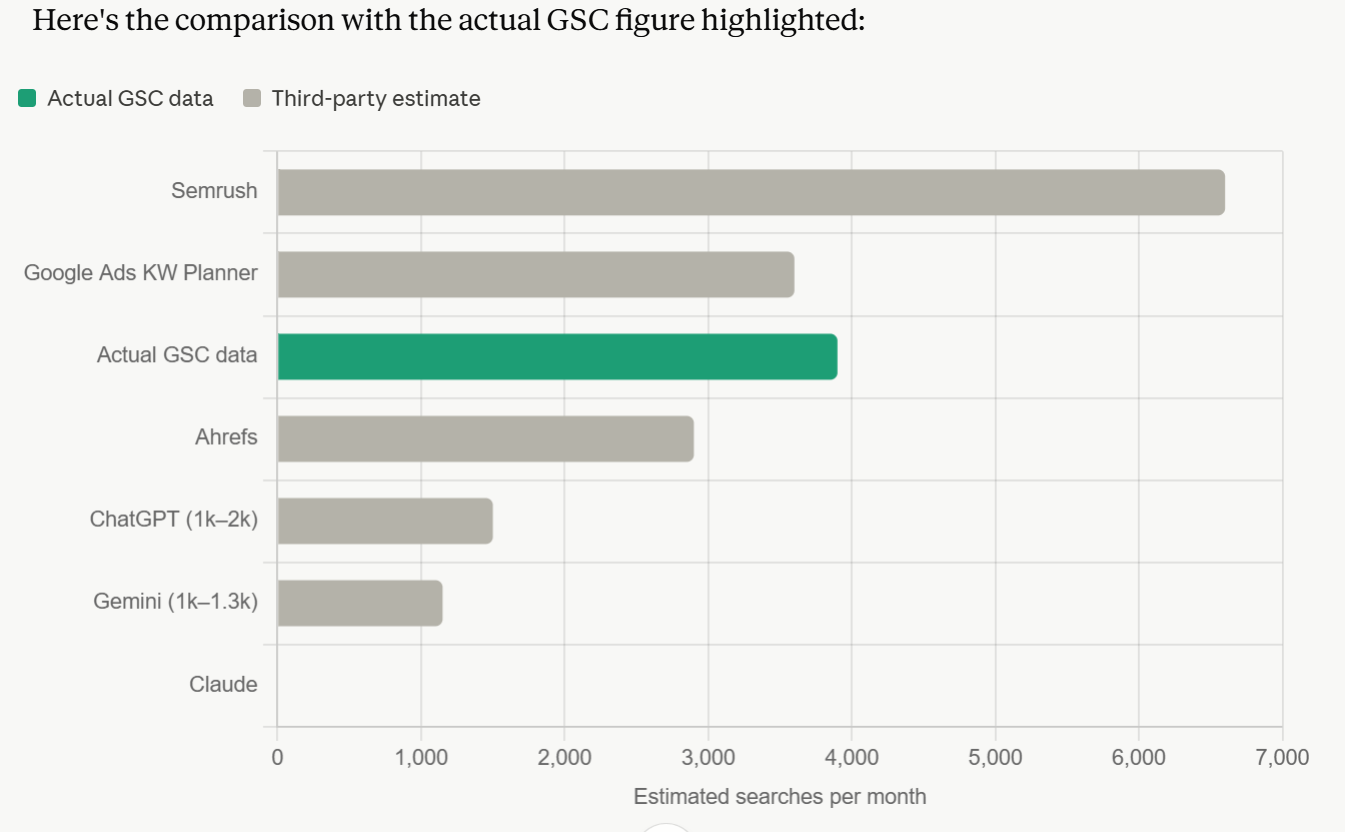
Can you use AI for keyword research?
Yes, you can use AI for keyword research. The harder question is whether the numbers it gives you are worth anything, and on that front I'd say no, not really.
This article walks through the whole thing. Whether you can do it, whether you should, what to watch for, and where the data falls apart. I'll run a live test across ChatGPT, Claude and Gemini, stack their numbers against the established tools, and finish with the part most people miss entirely, which is what happens when you try to use AI to research AI itself.
Let's start with the fundamentals before we get to any of that.
What keyword research actually is
Keyword research is the work of digging into keywords to understand how much they're searched, how that demand moves over time, and in some cases what they cost. It's not an SEO-only thing either. PPC, social, display and video teams all rely on it so that whoever's spending the budget knows what they're chasing.
The metrics that get used most:
Search volume, meaning how many people search a term over a given period
Search trends, so the shape of demand over time, including year-on-year movement, seasonal swings and event-driven spikes
Difficulty and competition
Commercial value, things like CPC and CPM
Intent and relevance
SERP features, from AI Overviews through to rich results
Boil it down and keyword research answers four things: what people search, how much, how often, and which way the trend is heading.
What each channel pulls out of that differs. An SEO will care about volume, trends, how hard a term is to rank for, what the SERP looks like, whether intent lines up, which features are showing and who's already there.
It's all still important, but there's a shift worth naming before we go further, and that's conversational search.
Keywords have traditionally been short. Single words or small combinations, most landing somewhere between three and five words, with reported volume dropping off a cliff beyond that. SEO has leaned on this kind of research at the front of every campaign for 25+ years. That's changing as AI and LLM conversational search grow, because people typing into an AI tool tend to write far longer phrases. Part of that is down to LLMs simply working better when you feed them more personal detail.
Whichever way you cut it, keyword research is the opening phase of most SEO campaigns and it sets the direction for everything that follows.
Search volume and trends
Of all the metrics, search volume is the one people obsess over. It's just the number of times a term gets searched in a window of time, normally counted per month, occasionally per year. Monthly is the standard.
SEOs have never been short of tools to get at it. There are hundreds out there, but the names you'll hear most include:
Google Ads keyword data, which is built for PPC but whose indicative figures get borrowed for SEO
Ahrefs Keyword Explorer
SEMrush keyword tools
Keyword Sh*tter
DataForSEO
SE Ranking
Plenty more besides.
I don't want to wander too far off the AI question, but the principle underneath this matters, so stick with me.
You want to target terms people genuinely search, so you open a tool and pull the volume. Simple enough. I'll run Ahrefs Keyword Explorer for the examples, though every tool draws on its own underlying data. And that's the thread to hold onto through this entire piece: feed the same keyword into different tools and you'll get different volumes back. Anyone doing this work needs that baked into how they read the numbers.
Here's a live one. I'll use the term SEO consultant, partly because my own site at www.danielfoley.co.uk ranks for it in Google :)
[screenshot: danielfoley.co.uk ranking for SEO consultant]
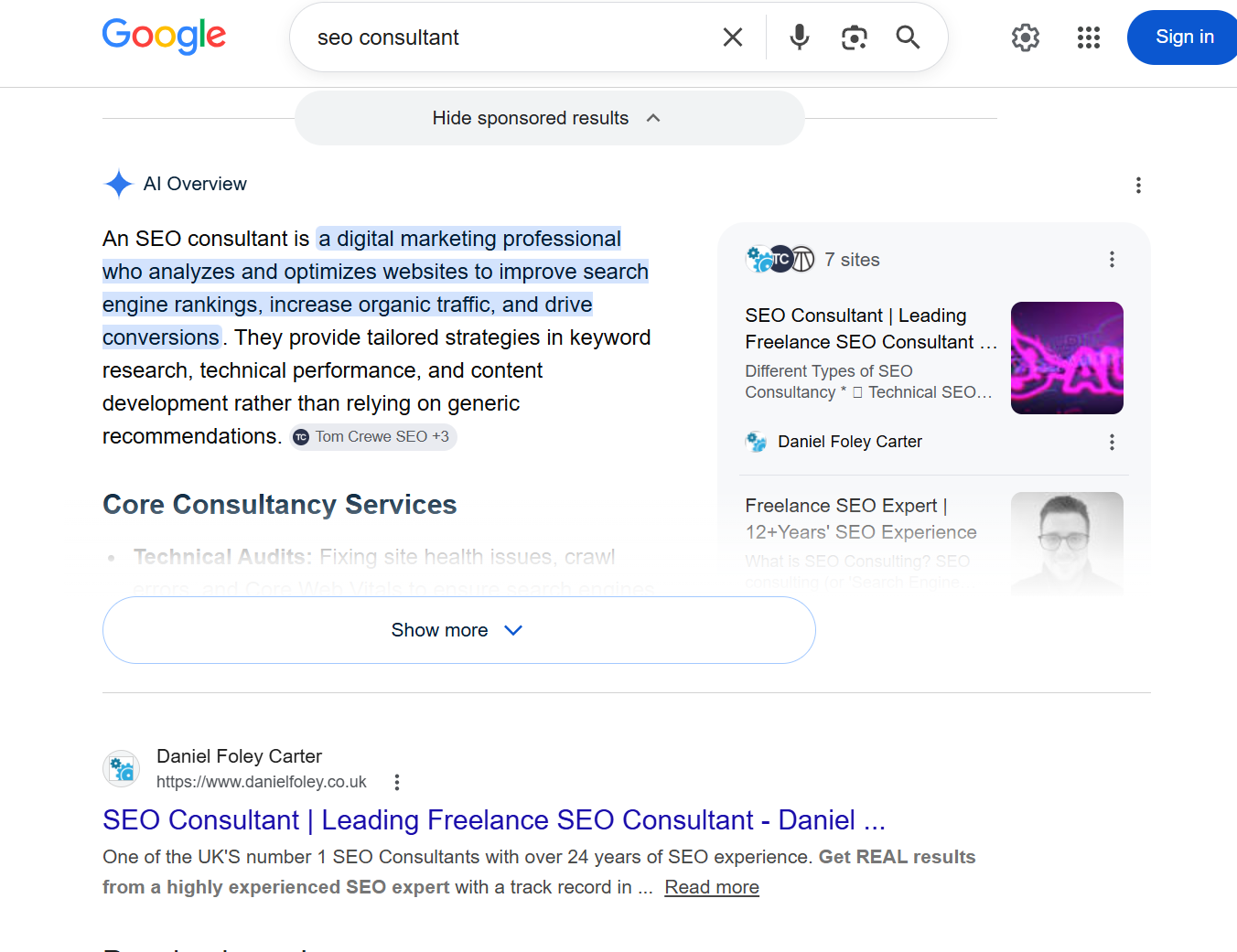
I've picked my own site deliberately, because I've got Google Search Console data behind it, and Search Console is the strongest source of truth there is for volume. More on that shortly.
So, SEO consultant. Pretend I wanted to rank for it and didn't already. Depending on what's in my stack, I might reach for Ahrefs Keyword Explorer, SEMrush keyword overview, or whatever else I happen to run.
Through SEMrush, the overview hands me this:
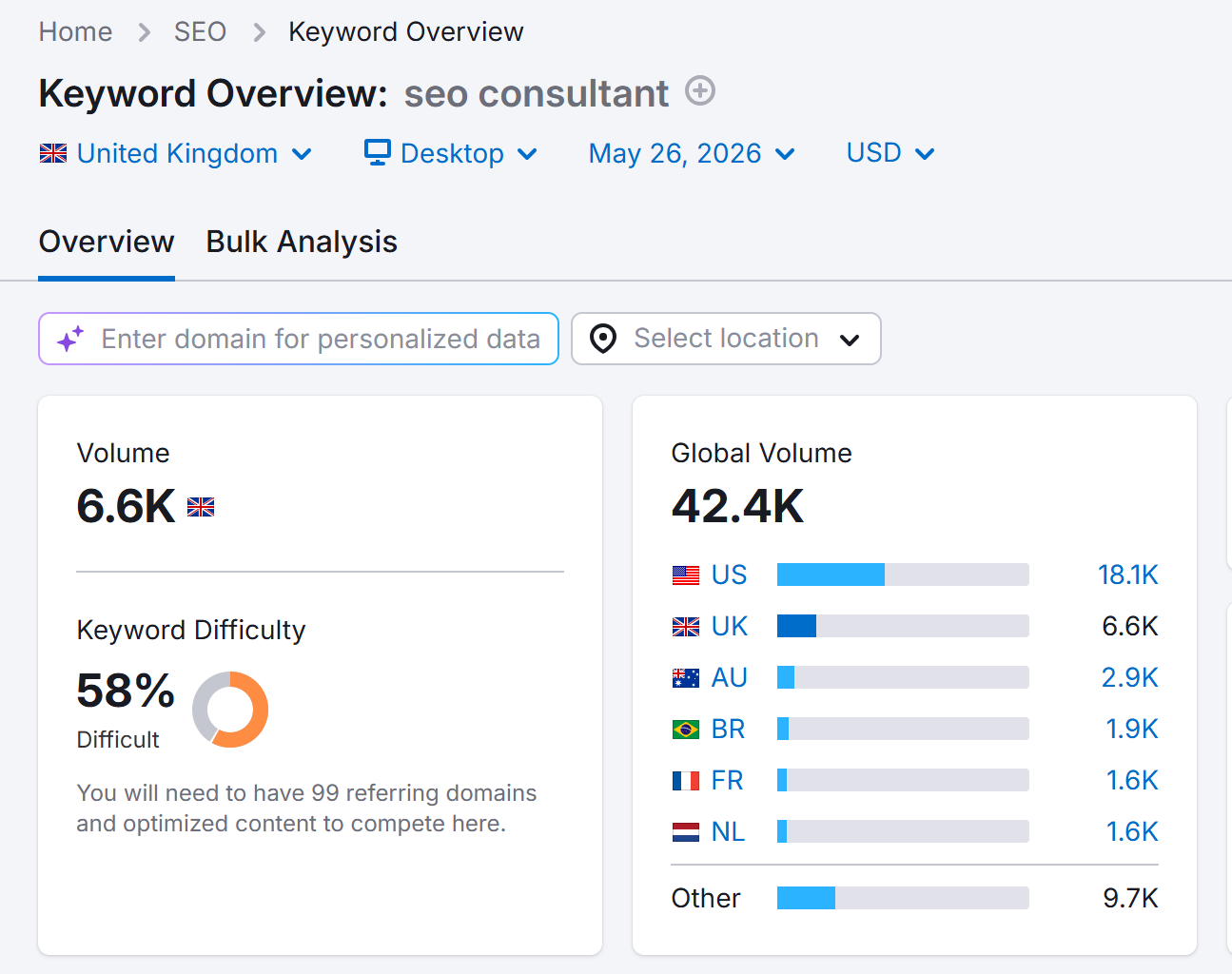
SEMrush calls it at 6,600 searches a month, with difficulty pegged at 58%.
Now picture a competitor who runs Ahrefs going after the exact same term. Their Keyword Explorer shows:
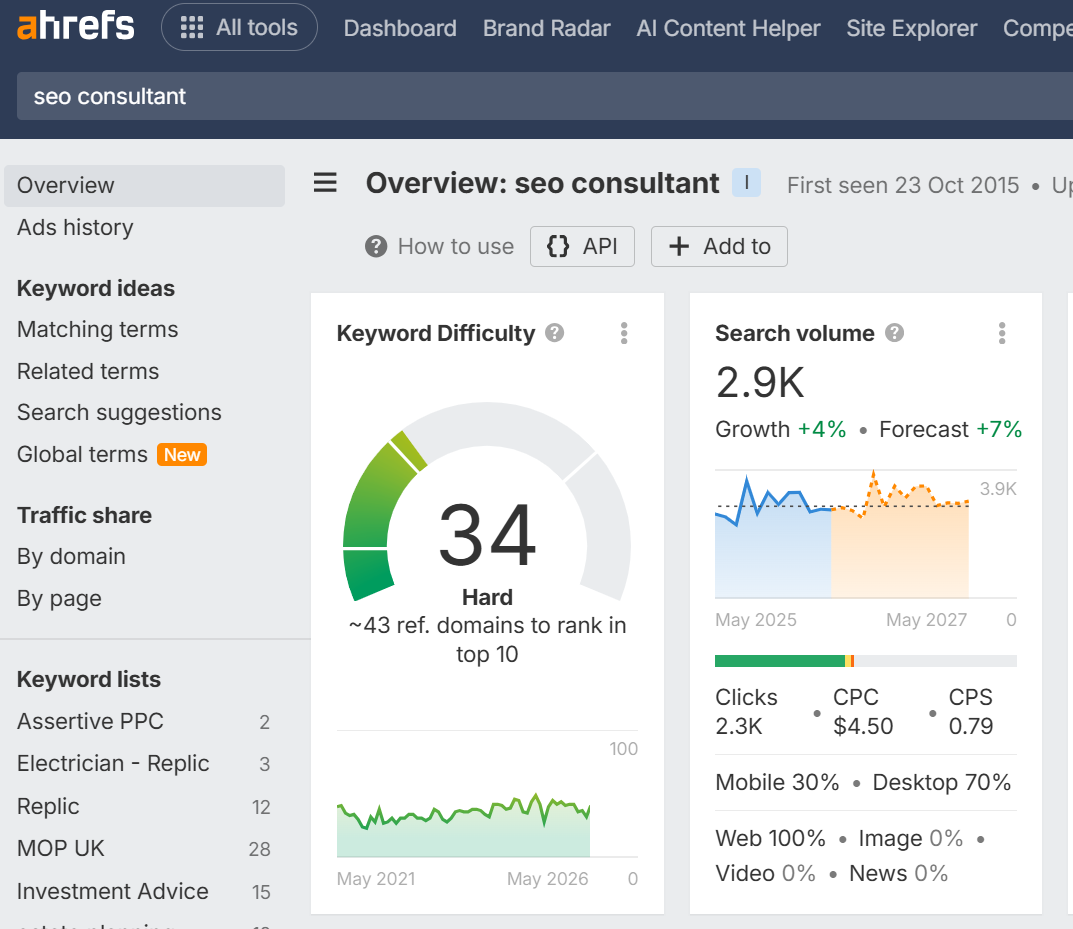
Ahrefs says 2,900 a month, difficulty 34/100.
Two tools, one keyword:
SEMrush - 6,600 a month Ahrefs - 2,900 a month
That's a wide gap on a term that isn't even particularly busy.
Let's add Google Ads Keyword Planner into the mix:
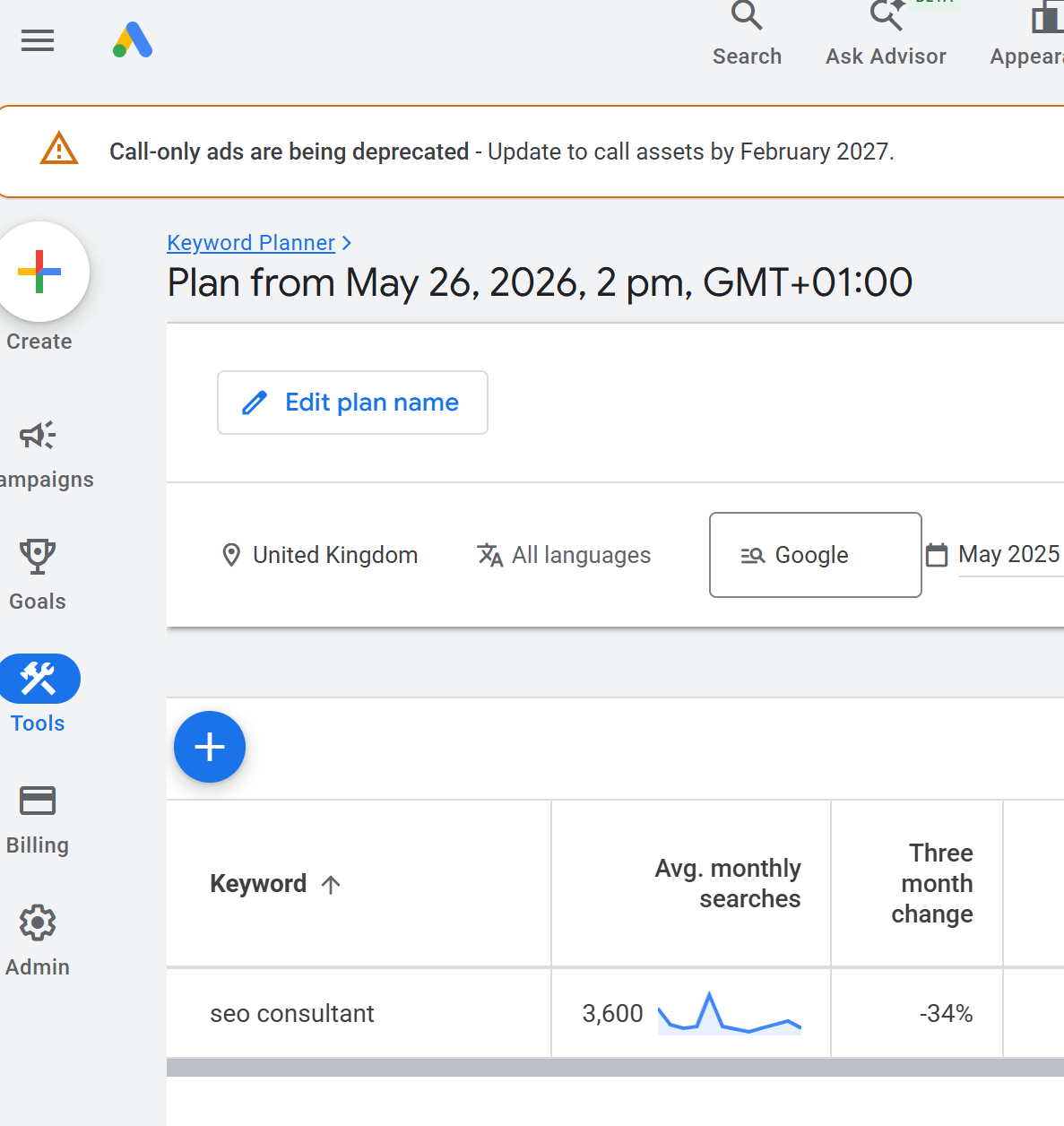
Google lands at roughly 3,600 a month for the UK, dropping it neatly between the other two.
Three sources, three answers, and SEO consultant is a modest term. Scale up to higher-coverage keywords and these gaps only get wider.
The lesson writes itself. Keyword tools are educated guesses, and you treat them as such.
Right, this is meant to be about AI, so let's actually test it.
ChatGPT on SEO consultant
First up, ChatGPT. I asked it straight: "can you do some keyword research on the term 'seo consultant' for the UK and give me any search volume data / trend data you have?"
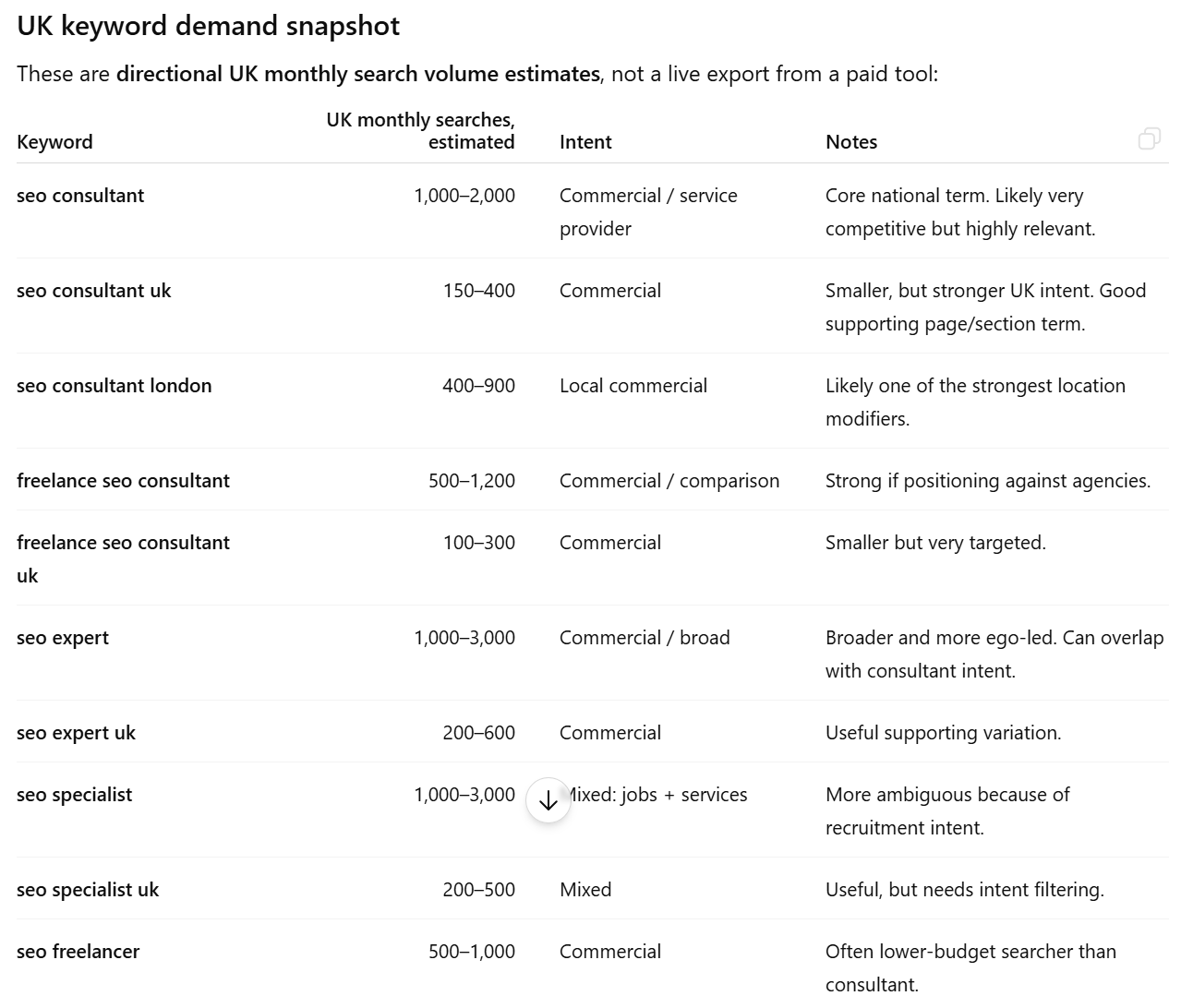
It came back with 1,000 to 2,000 searches a month, the lowest read so far.
Running total:
SEMrush - 6,600 a month Ahrefs - 2,900 a month Google Ads Keyword Planner - 3,600 a month ChatGPT - 1,000-2,000 a month
Notice it gives a bracket rather than a single figure.
I asked where the number came from:
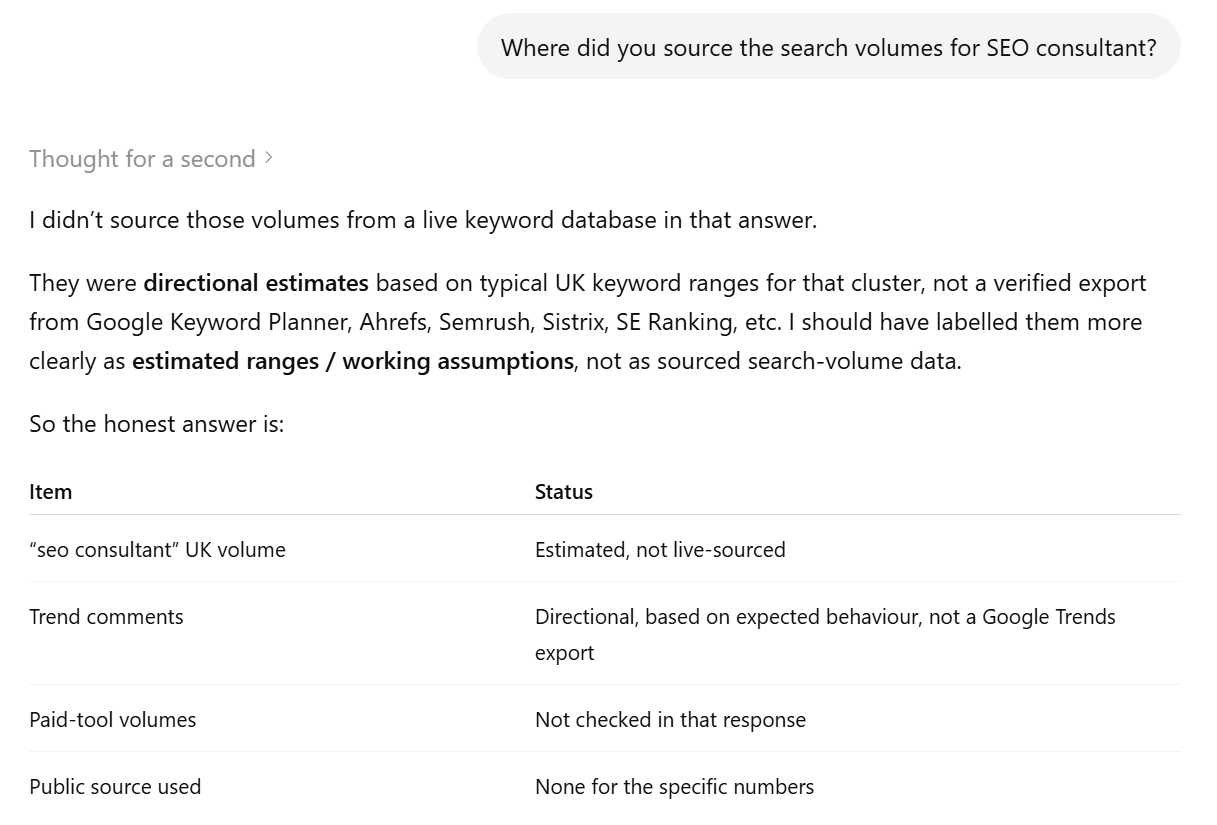
No real answer, so I went again:
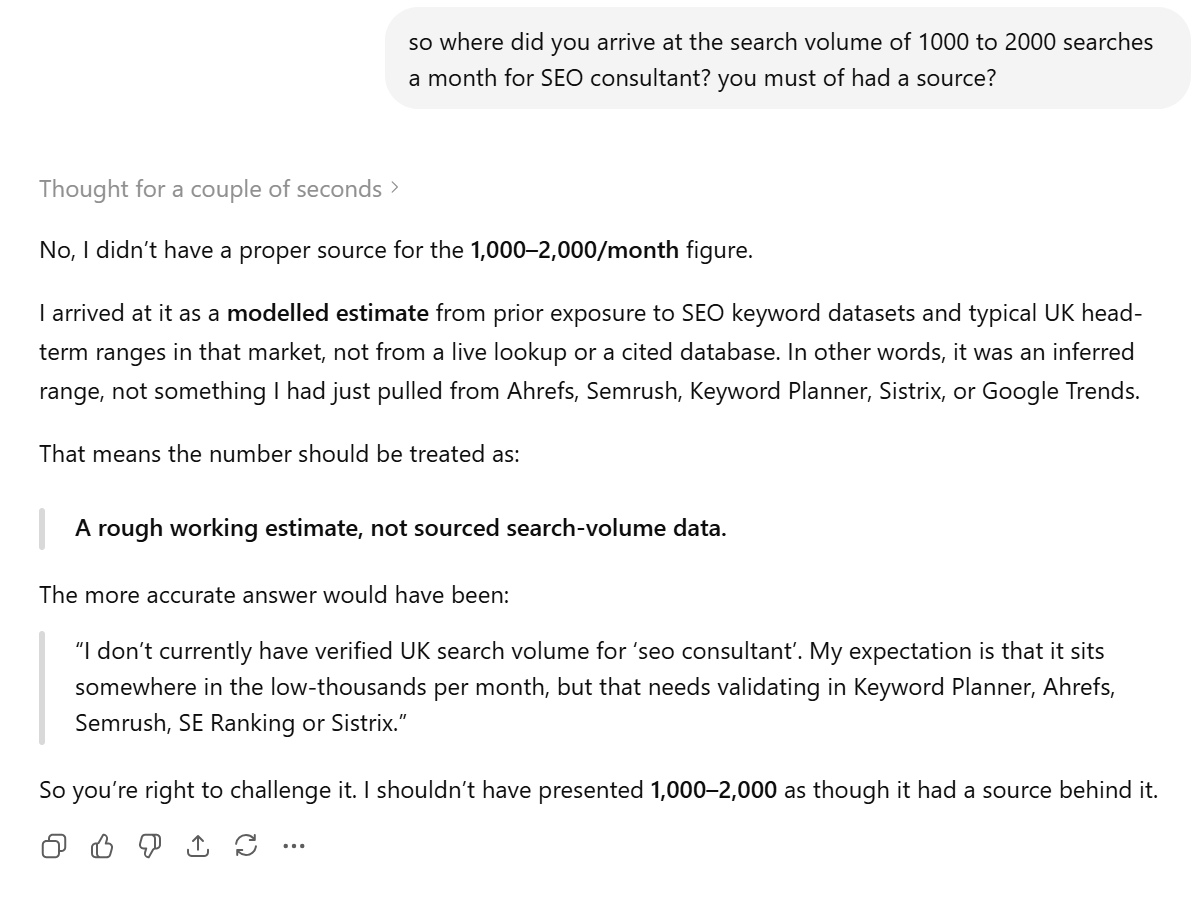
What it amounts to is this. Somewhere in training it absorbed data that happened to carry volume figures, and to its credit it admits the output is a modelled estimate.
Knowing how LLMs operate, that's not something you build a campaign on.
Claude on SEO consultant
Quick confession, I'd left the Ahrefs connector switched on and forgotten about it:
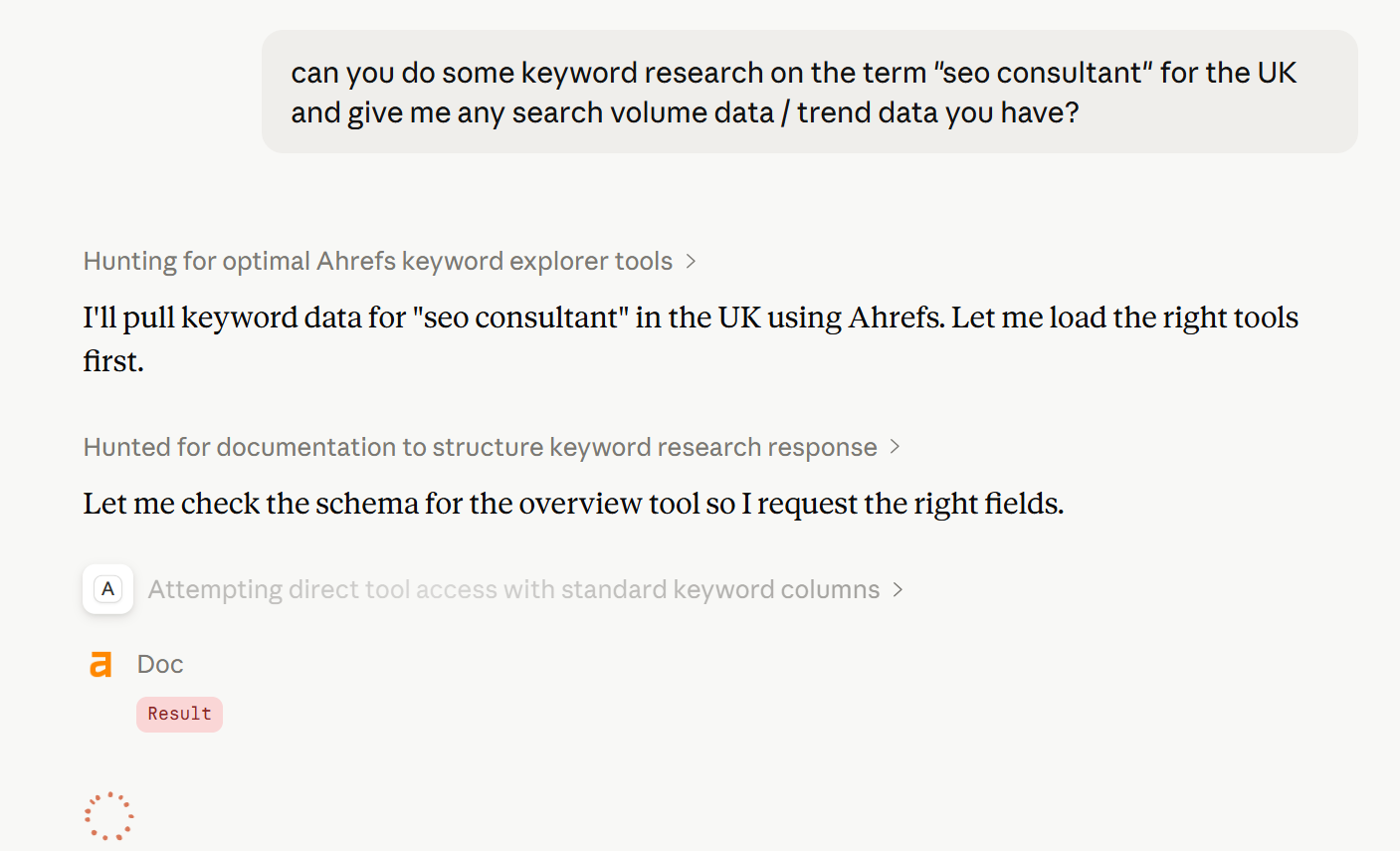
I stopped it, told it to drop the Ahrefs connector and MCP, then asked it to work from its own sources:
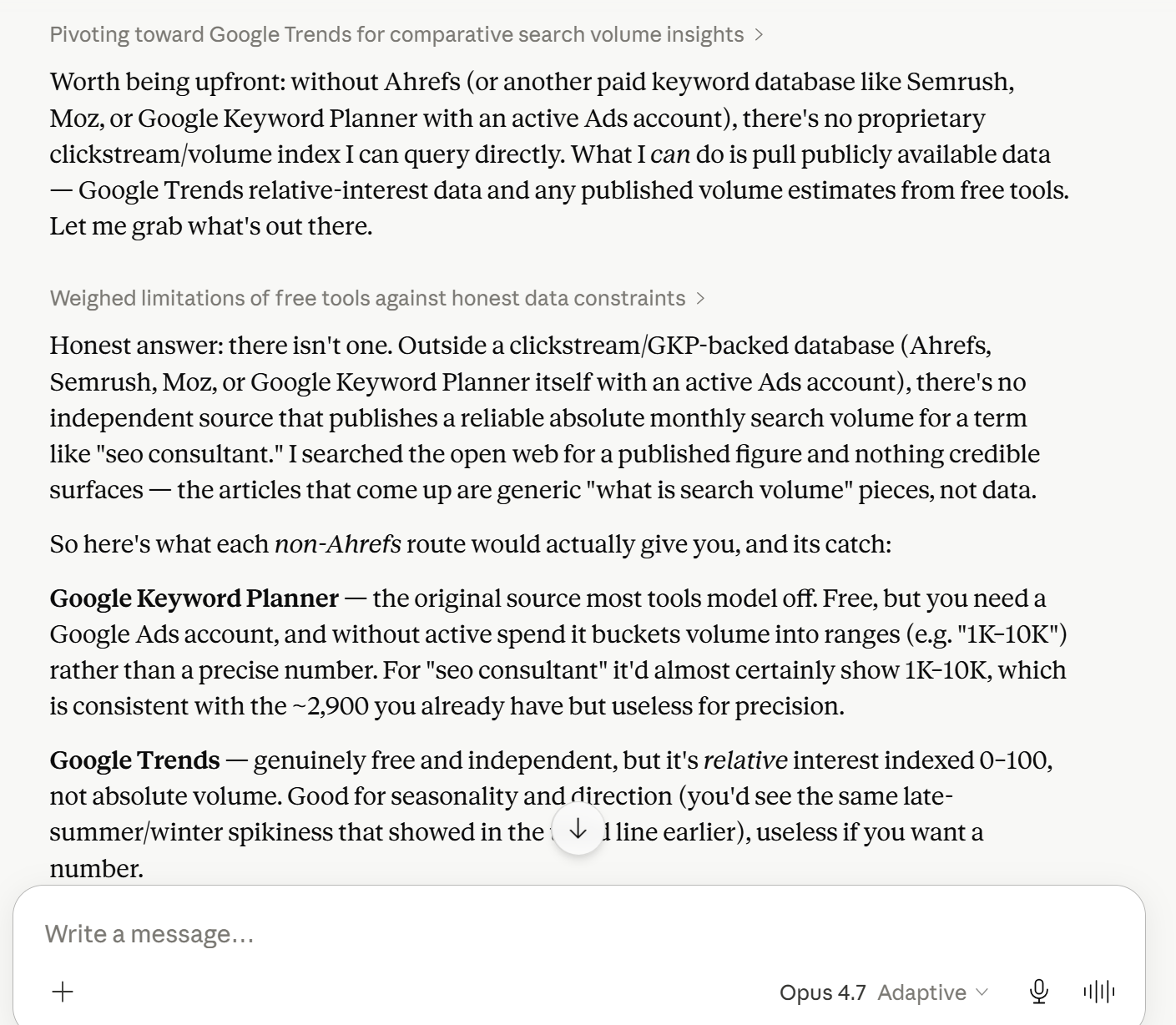
This bit was interesting. It pushed back, and it was correct to. It said it didn't hold the data and steered me toward Google Keyword Planner and Google Trends instead, which is a genuinely sensible answer.
I leaned on it harder, but the only figure I could get out of it traced back to the Ahrefs Keyword Explorer data:
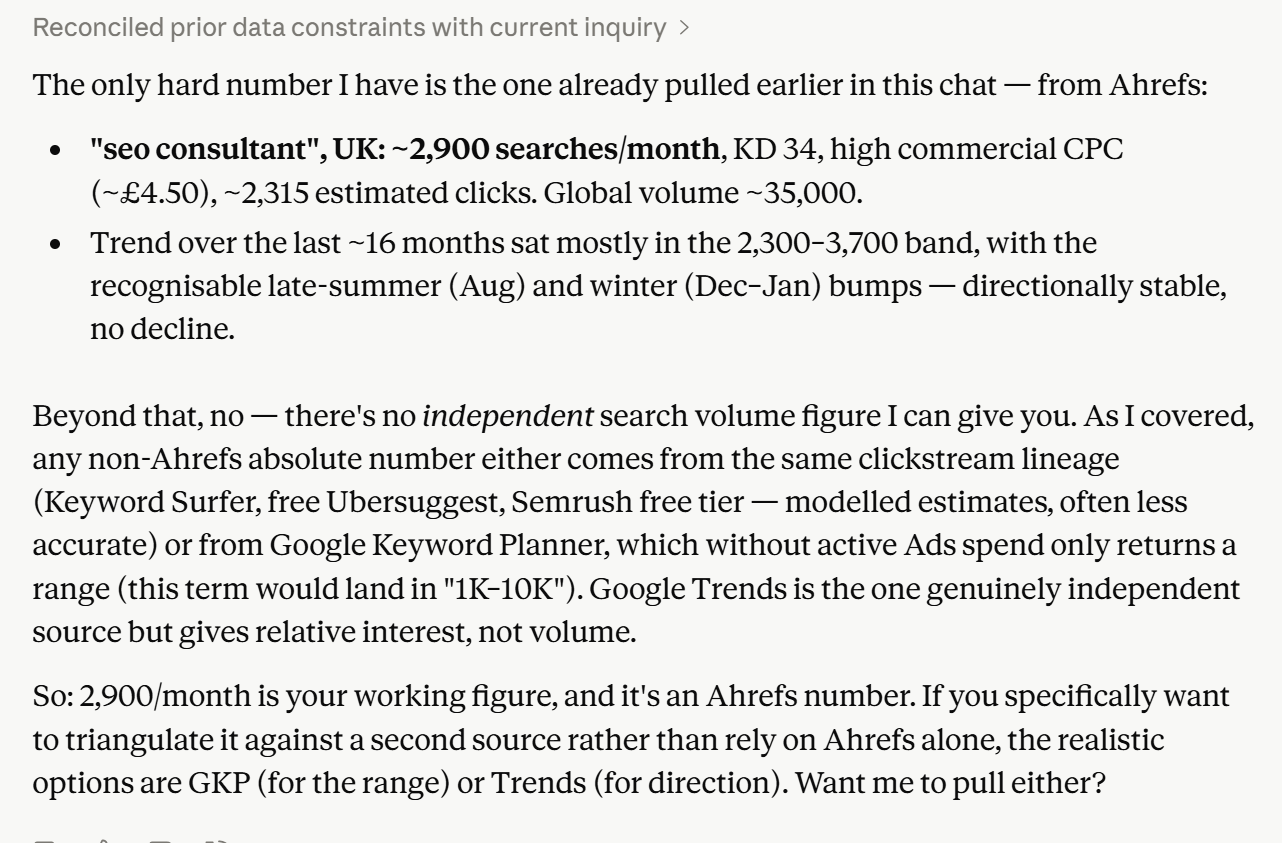
So no usable first-party number from Claude. Refusing was the right call though, far better than dredging up training data or fabricating something, which LLMs do constantly. That tendency is precisely why they're the wrong tool for this job.
Gemini on SEO consultant
Gemini's turn:
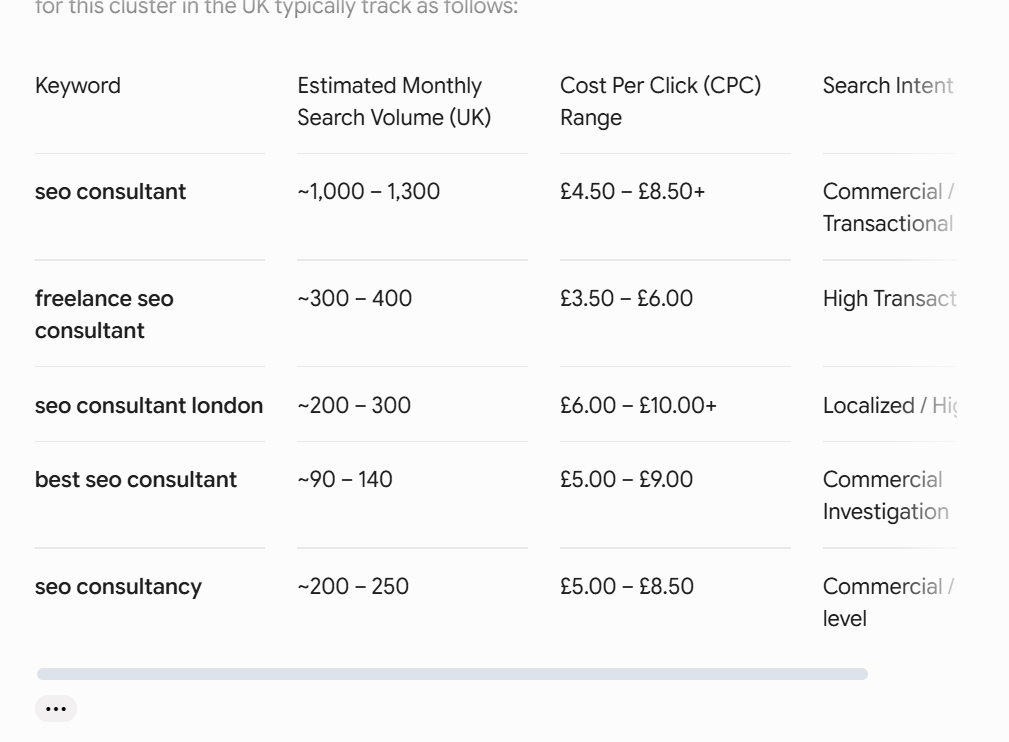
Like ChatGPT it handed back a bracket, this time 1,000 to 1,300 a month, the most conservative number on the board.
When I asked for the source:
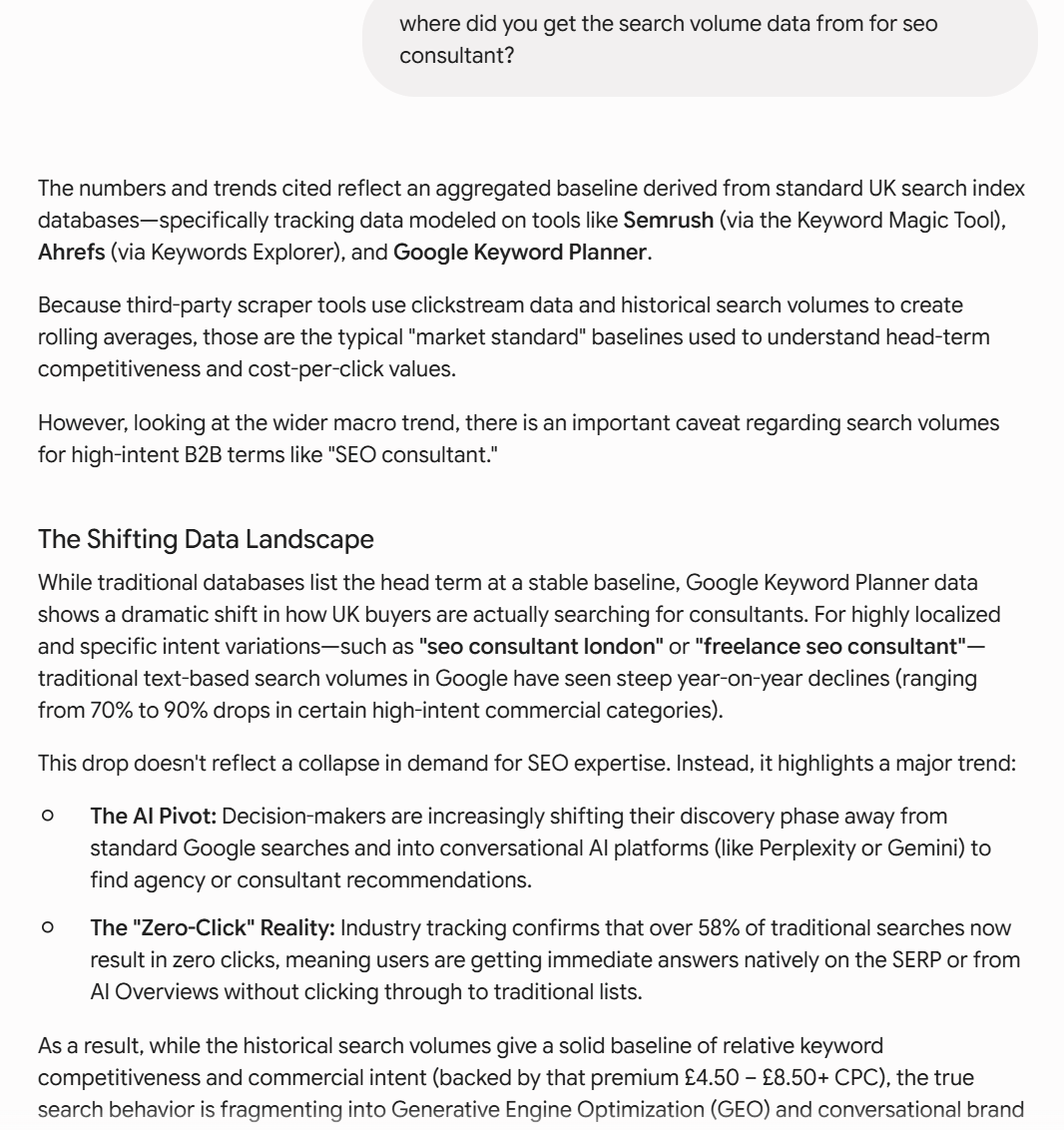
It told me it was an aggregated baseline pulled from standard UK search index databases and named Ahrefs, SEMrush and Google Keyword Planner. That falls apart the moment you think about it, because we've already watched those three disagree. If Gemini was really blending them, the figure would sit higher than 1,000-1,300. So it isn't drawing on them at all, whatever it claims.
Where everything lands:
SEMrush - 6,600 a month Ahrefs - 2,900 a month Google Ads Keyword Planner - 3,600 a month ChatGPT - 1,000-2,000 a month Claude - no data Gemini - 1,000-1,300 a month
Not much to work with. We know demand exists, so targeting the term is fine, but it's a bit beside the point when the volumes are this all over the place. The useful signal is just that there's demand at all, and for a term like SEO consultant, which pairs a service with an operator, you'd bank on that regardless.
Estimated volumes vs Search Console data
Here's the thing to get straight on Google Search Console. It's the nearest thing to real data you'll find, but there's a chicken-and-egg problem: you only get it once you rank. So the notion that you can lean on Search Console before you've got any rankings doesn't really stand up.
My advice is to treat it as a two-stage thing. Do your keyword research, launch the strategy, then keep an eye on the Search Console data as it accumulates. That's when you get a properly reliable picture of what's actually searched, long-tail variations and all, plus the rather lovely ZSV (zero search volume queries).
Worth remembering too that keyword research starts from a seed term, but you'll typically end up ranking for a whole spread of variants around it.
To show what I mean:
Ahrefs throws up thousands of ideas off the back of SEO consultant alone:
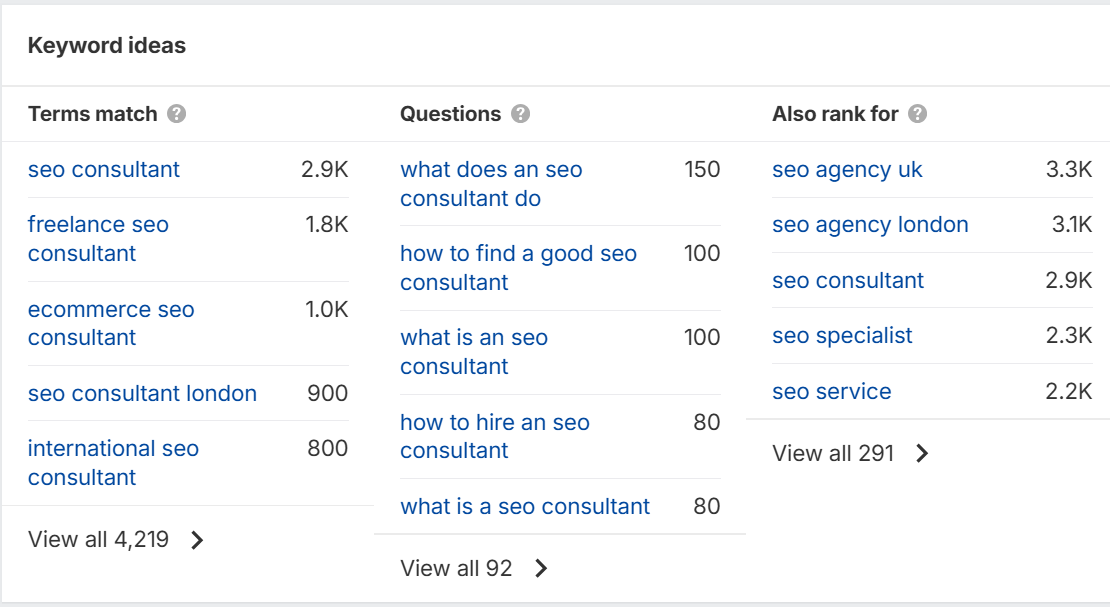
There's normally serious opportunity buried in here:
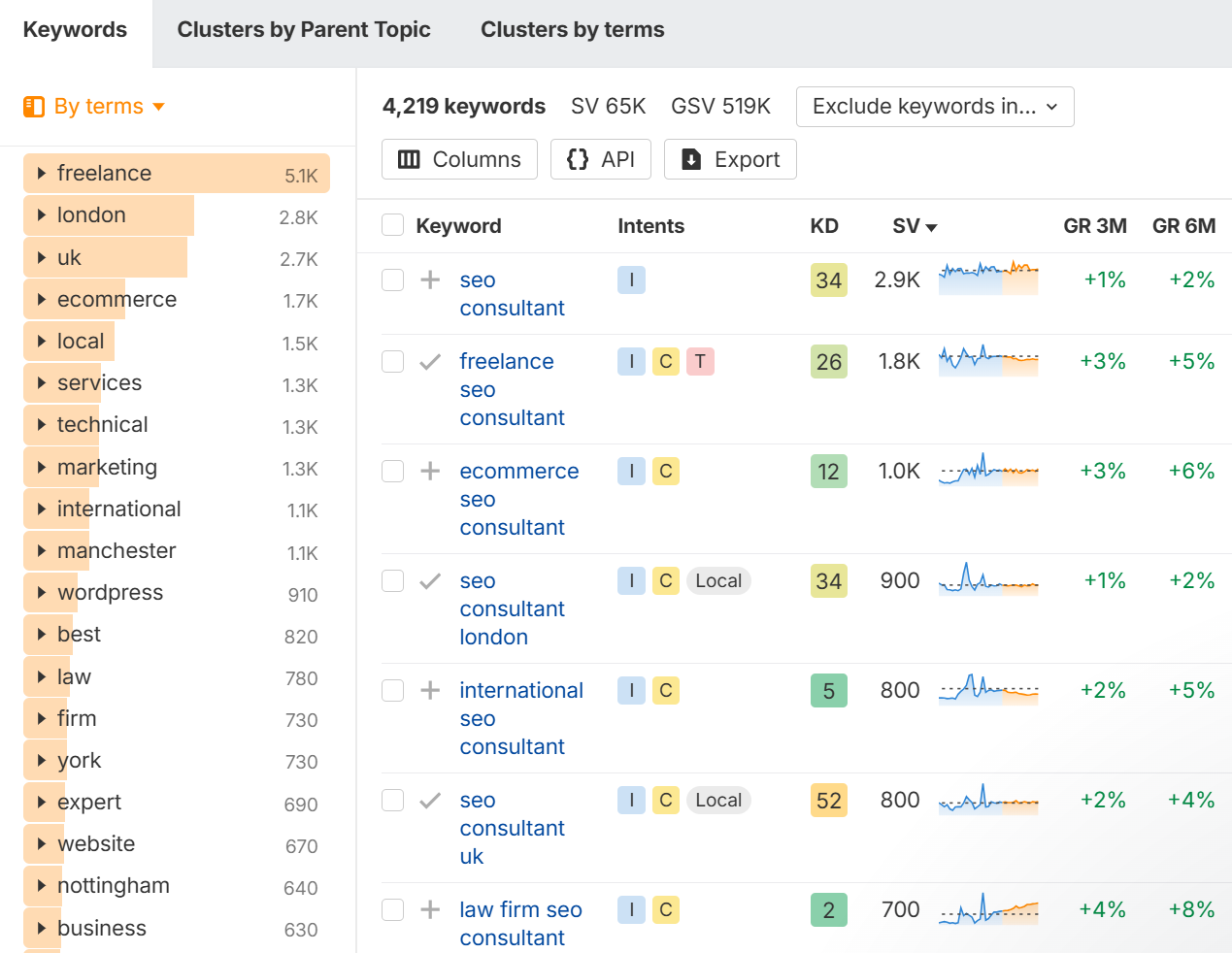
Keep that in your back pocket.
We choose a core keyword to rank for, then account for the long-tail trailing behind it.
Something else to bear in mind: most keyword tools badly under-report what's genuinely out there.
Search Console is the goldmine for long-tail. We run our GSC data through SEO Stack, and for "SEO consult" (which sweeps up both consulting and consultancy) we get:
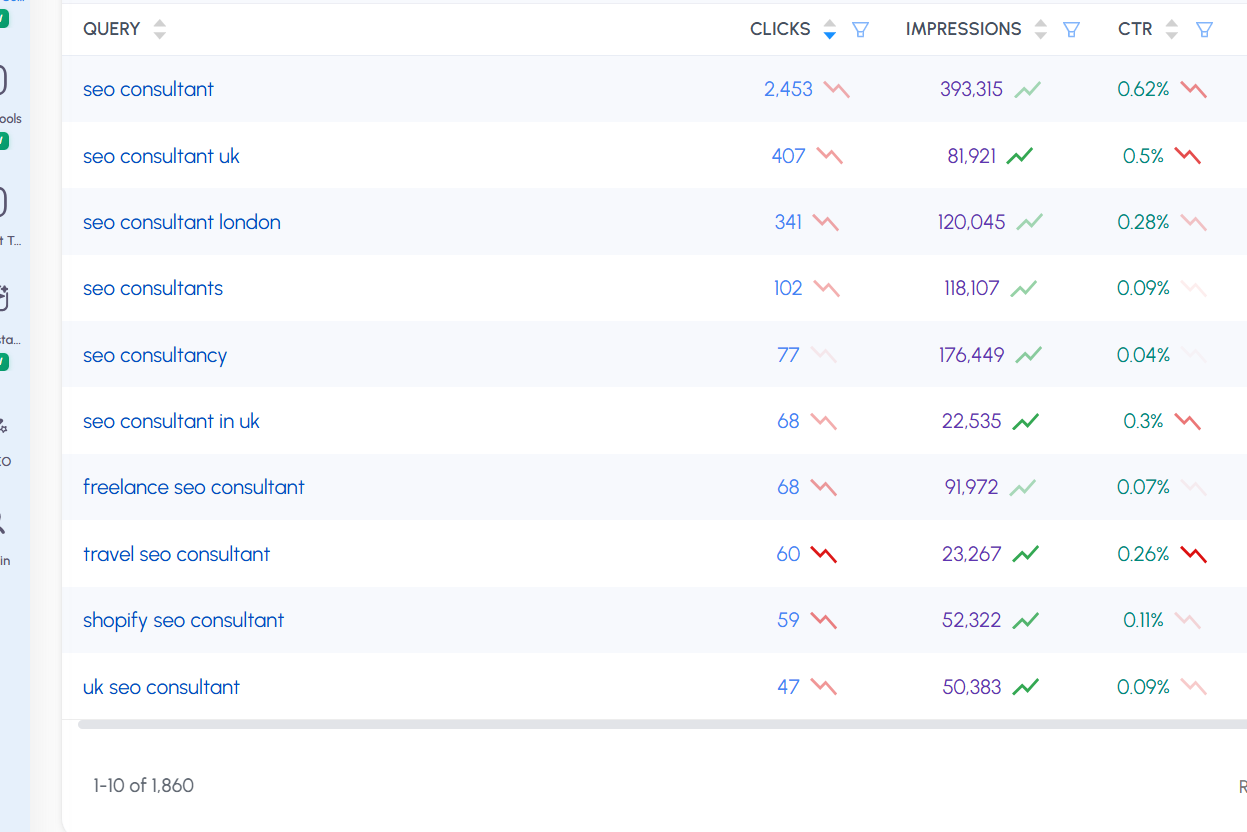
That's 1,860 keywords. Enormous.
Back to the research itself. The reason I built this around www.danielfoley.co.uk is that I sit at an average UK position of 1.6 for SEO consultant, which makes my impression data about as close to true search volume as you'll realistically get. That gives us a clean benchmark to hold the traditional tools and the AI numbers against.
Pulling SEO consultant in SEO Stack (www.seo-stack.io, free to try):
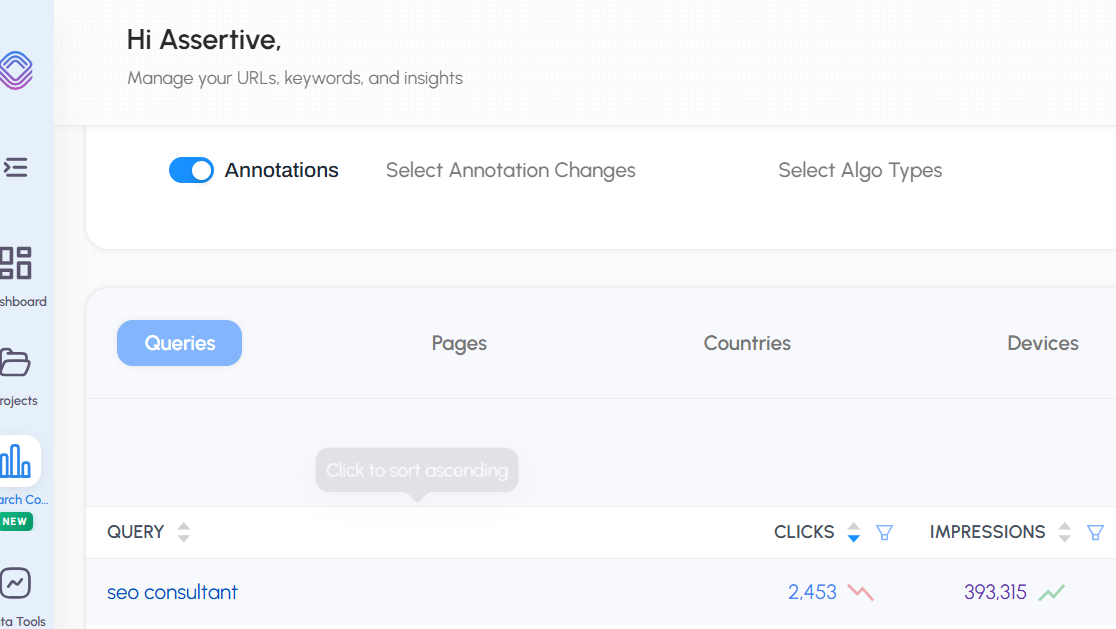
To get a monthly average, we divide the impressions by however many months the data covers:
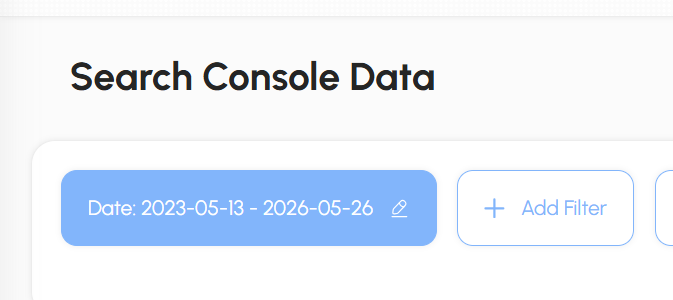
There's three years here, so 393k impressions divided across 36 months.
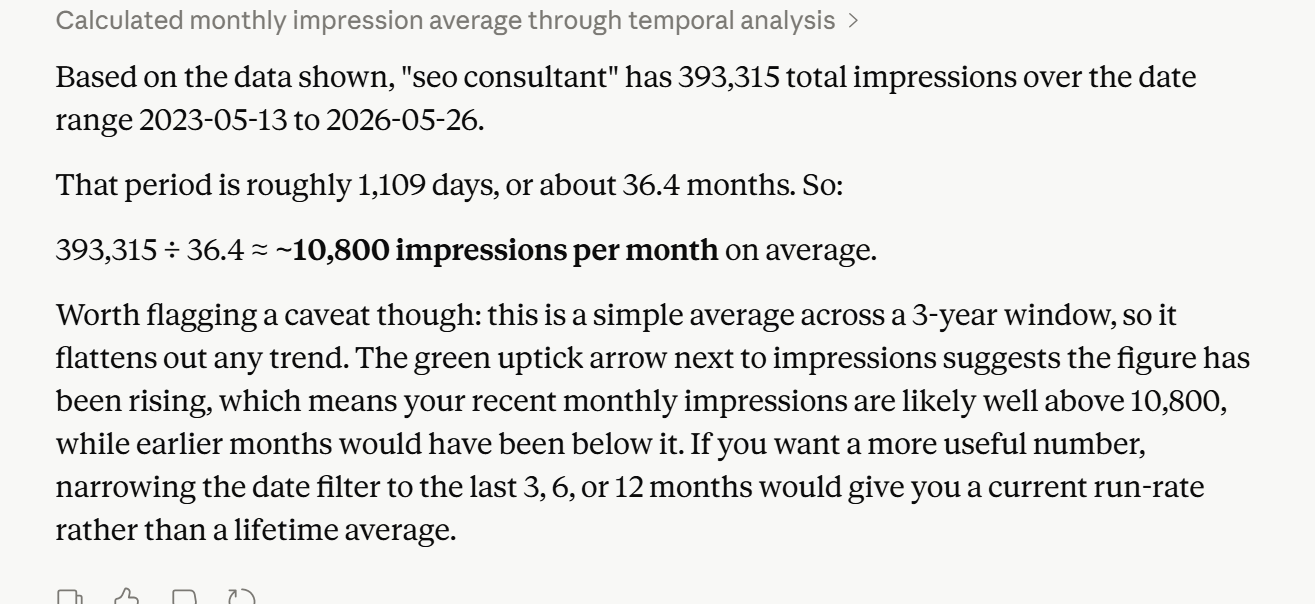
Then a UK filter on top:
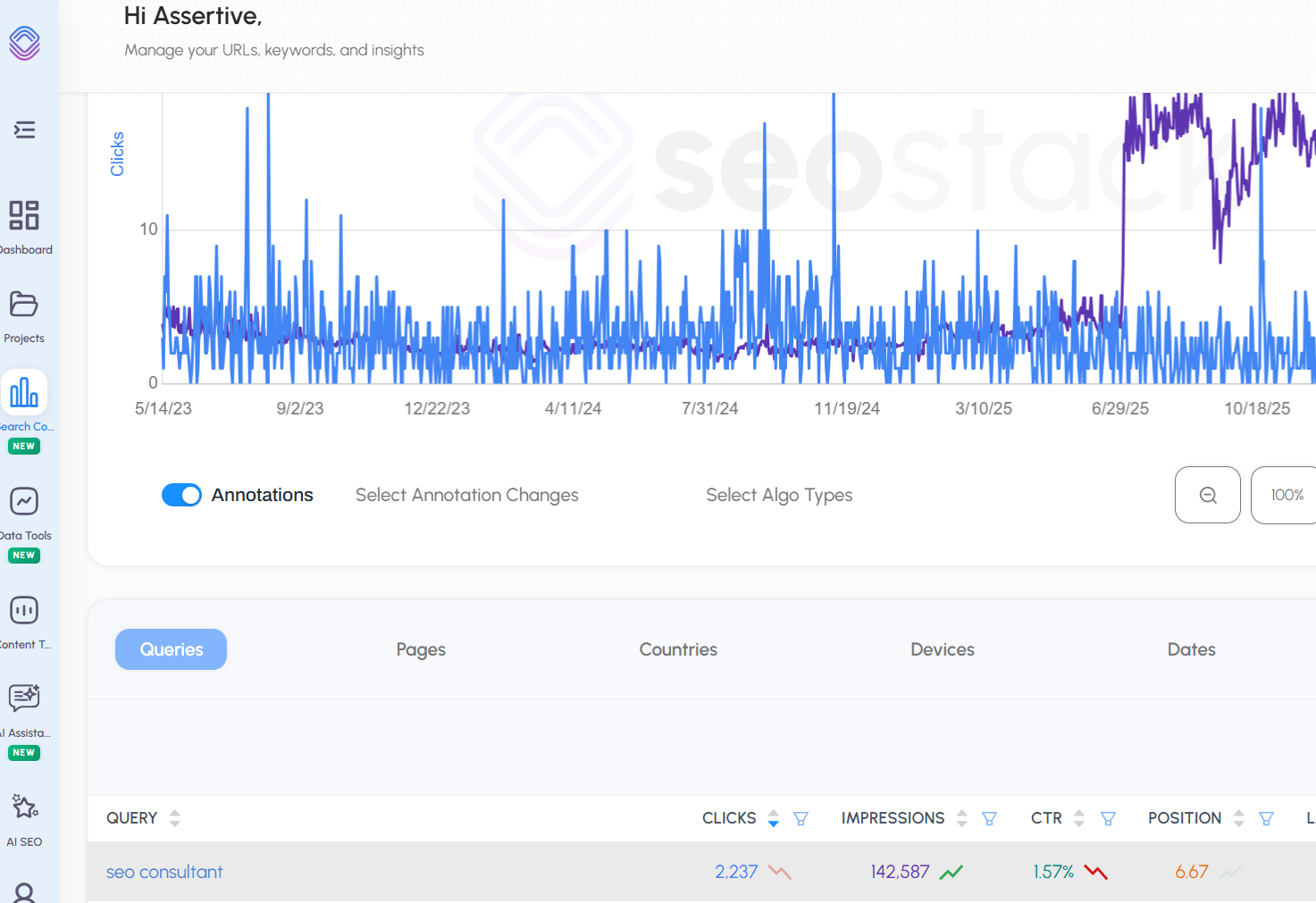
Which leaves us with:
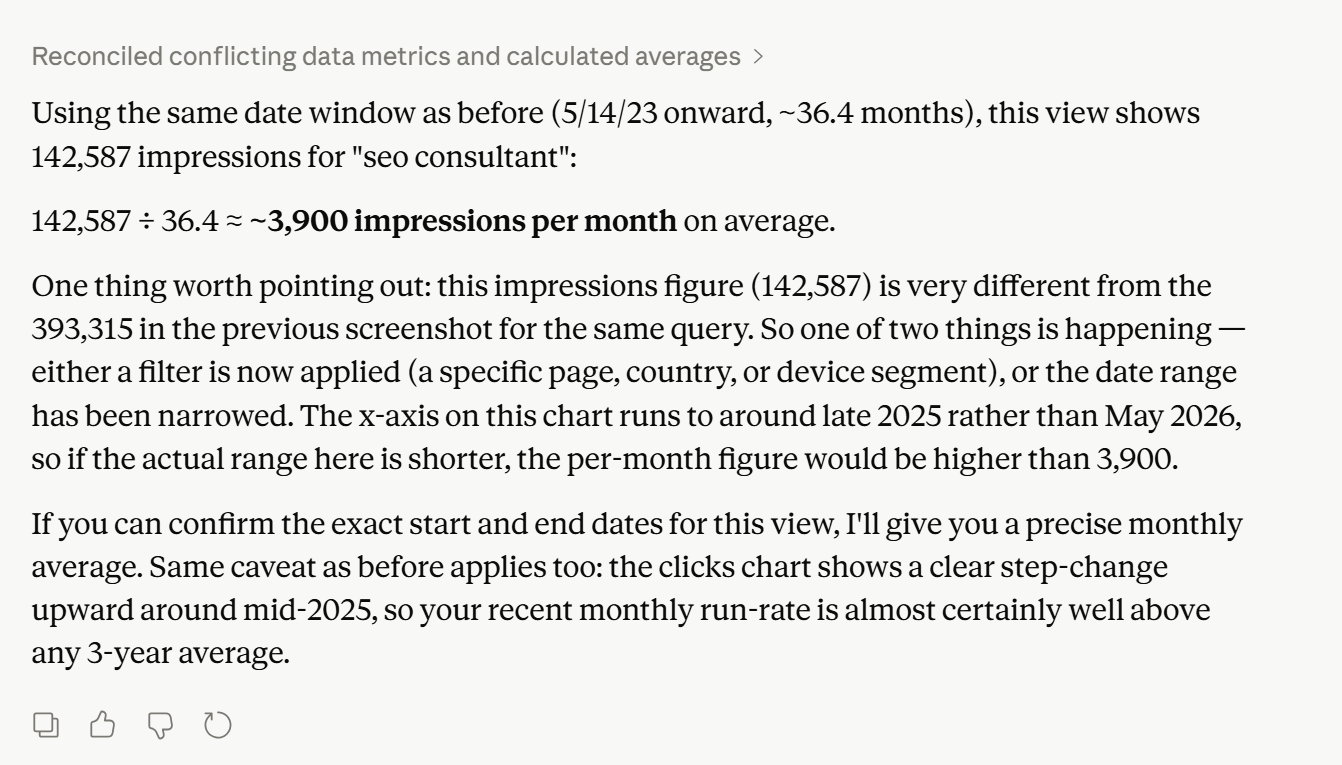
SEMrush - 6,600 a month Ahrefs - 2,900 a month Google Ads Keyword Planner - 3,600 a month ChatGPT - 1,000-2,000 a month Claude - no data Gemini - 1,000-1,300 a month Actual GSC data - 3,900 a month
The winner on accuracy was Google Ads Keyword Planner. You'd half expect that, but don't take it as a rule, because Keyword Planner is often well off the mark itself. It just happened to nail it here.
Plotting it out:
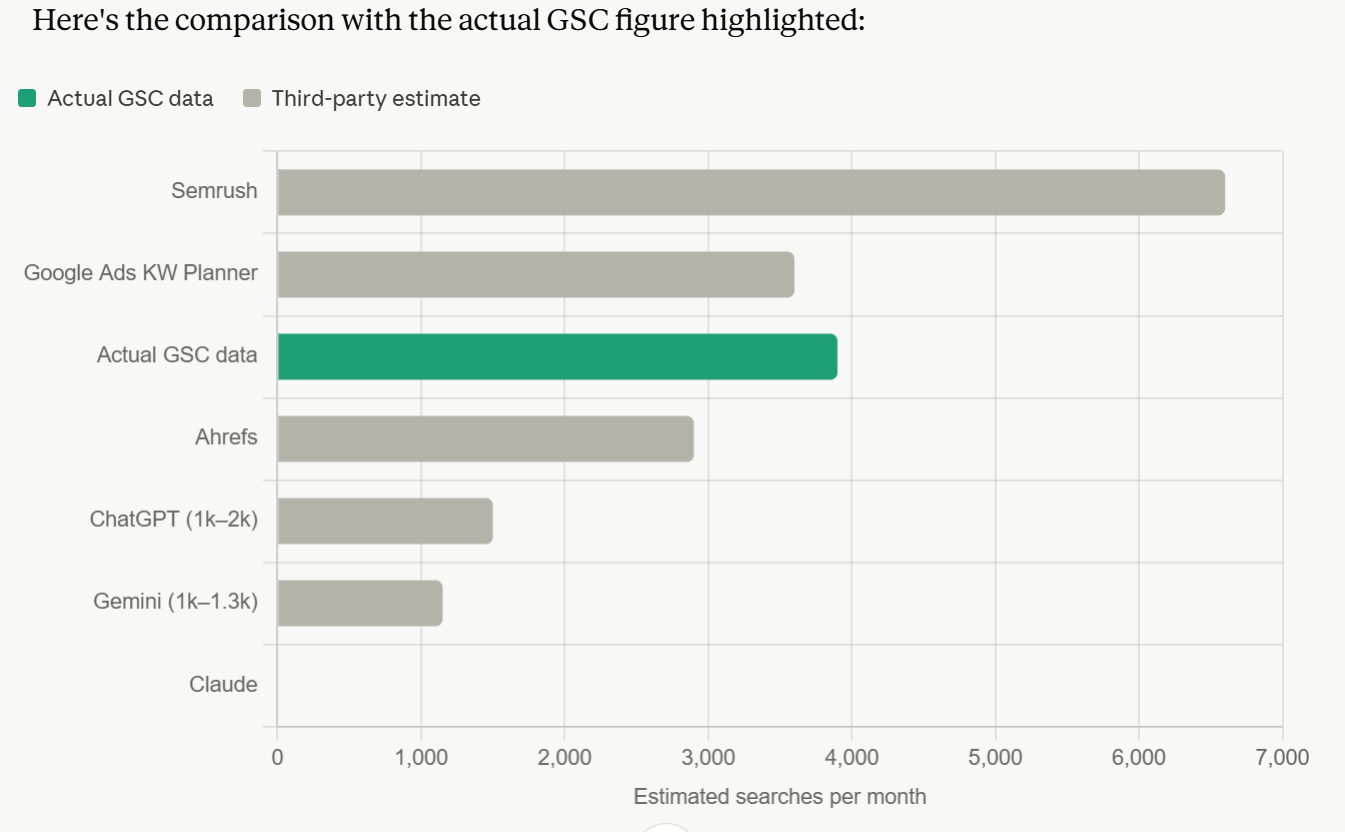
SEMrush and Gemini drifted furthest from reality, while Ahrefs and Google Ads Keyword Planner sat closest to the real figure.
So, can you use AI for keyword research?
Sort of. Gemini and ChatGPT will give you ballpark numbers, but the gap between those and reality is usually big enough to cause problems, which shows up as:
Volume estimates that are simply wrong
Zero data on terms that clearly do get searched
Long-tail opportunities going unseen
Volumes that come back inflated
The root of it is that LLMs have no search volume metric to draw on. They've only got their training data, and when you layer one shaky dataset over another, you get output that's too far off to trust for SEO, AI SEO, GEO or anything else.
The paradox of using AI to research AI
This is where it gets properly awkward. Try to use AI to research data about AI itself and you hit a wall, because there's no defined source feeding the answer. It's either pre-training data or it's synthesised on the spot. Google at least gives us Search Console. The LLMs, whether that's Gemini, Claude, ChatGPT or Grok, have no equivalent. There's no webmaster's dashboard, and they don't publish prompt volume data to anyone.
Those platforms are the only places that hold the truth, and since none of them share prompt data with advertisers, anything you manage to extract is invented rather than measured.
On top of that sits a paradox that's genuinely worth sitting with. The longer a search phrase gets, the lower the odds it's ever searched again.
[screenshot: query length data]
Traditional Google searches mostly run four words or fewer. LLM prompts tend to run 5+ words, and a fair chunk push past nine. At that length the chance of the identical search recurring drops away fast.
That's exactly why the prompt search volume you see on most LLM and AI visibility trackers is hot garbage. There's nothing solid underneath it.
So no, leaning on AI for LLM research, prompt research, or even bread-and-butter keyword research isn't a sound move.